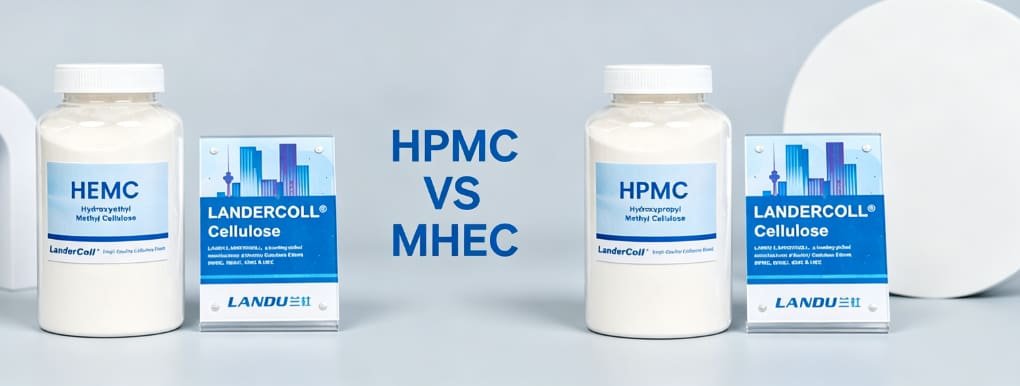
HPMC vs MHEC: Which Cellulose Ether Performs Better in Construction Mortars
A tile adhesive may perform perfectly during laboratory testing but still create problems on-site during real installation.
Under summer conditions, installers sometimes notice the mortar losing tack too quickly before tiles can be adjusted properly. On vertical surfaces, heavy tiles may begin slipping before alignment is completed. In skim coat applications, the surface can dry unevenly, making finishing more difficult as working time shortens unexpectedly.
In many cases, these problems are not caused by cement quality or sand grading alone.
The issue often starts with cellulose ether selection.
This is why the discussion around HPMC vs MHEC has become increasingly important in modern dry-mix mortar formulations.
Although both additives are widely used in cement-based mortars, they do not behave exactly the same under real construction conditions. Differences in water retention stability, thermal behavior, open time, and rheology can directly influence application performance on the jobsite.
For mortar manufacturers, formulators, and construction chemical suppliers, selecting the correct cellulose ether is no longer only about viscosity. It is about achieving stable installation performance across varying temperatures, substrates, and application systems.
This guide compares HPMC and MHE from a practical construction perspective, focusing on tile adhesives, skim coats, EIFS mortars, gypsum plasters, and other dry-mix systems.
Why Cellulose Ether Selection Has a Bigger Impact Than Many Manufacturers Expect
In dry-mix mortar systems, cellulose ether controls far more than basic thickening behavior.
It directly affects:
- Water retention
- Open time stability
- Worker application feel
- Sag resistance
- Troweling smoothness
- Edge drying behavior
- Mortar consistency during installation
Small differences in cellulose ether performance can become highly visible under difficult jobsite conditions.
For example:
These issues are especially common when formulations are optimized only under controlled laboratory conditions rather than actual construction environments.
Experienced formulators therefore evaluate cellulose ether not only by viscosity, but by overall rheology behavior and real application performance.
Quick Comparison: HPMC vs MHEC
| Performance Area |
HPMC |
MHEC |
| Water Retention |
Good |
Higher stability under demanding conditions |
| Open Time Stability |
Balanced |
More stable in hot environments |
| Workability |
Smooth and versatile |
More stable during extended application |
| Hot Climate Performance |
Standard |
Better thermal stability |
| Anti-Sag Performance |
Good |
Often improved in vertical systems |
| Gypsum Compatibility |
Good |
Commonly preferred |
| Cost Efficiency |
More economical |
Usually higher-performance focused |
Neither option is universally “better.”
The correct choice depends on target mortar system and construction conditions.
What Is the Real Difference Between HPMC and MHEC?
Both HPMC and MHEC are non-ionic cellulose ethers widely used in construction mortars.
However, their substitution structures create noticeable differences in water retention, thermal stability, and jobsite behavior.
HPMC
HPMC offers a reliable balance between:
- Workability
- Water retention
- Cost efficiency
- Open time
- Mortar consistency
It remains the most economical and versatile choice for standard cement mortar production.
MHEC
MHEC excels under harsh jobsite conditions, providing:
- More stable water retention in heat
- Consistent open time
- Smoother extended troweling
- Better gypsum compatibility
Ideal for premium formulations and hot climate projects.
Common Selection Mistakes in Mortar Formulation
Many mortar performance issues come from wrong cellulose ether selection, not raw material quality.
Using standard HPMC in hot weather may cause:
Chasing only viscosity ignores real rheology balance and jobsite handling.
Temperature, humidity, and substrate absorption all change mortar behavior significantly.
HPMC vs MHEC in Different Construction Applications
Tile Adhesive Systems
Standard formulations use HPMC for balanced cost-performance.
Hot weather and large-format projects prefer MHEC for stable open time and anti-sag performance.
Skim Coat & Wall Putty
HPMC works well for general use. MHEC delivers smoother finishing and longer working time in warm conditions.
Gypsum-Based Mortars
MHEC is usually more compatible with gypsum hydration and stability requirements.
EIFS / ETICS Mortars
Vertical façade stability needs reliable water retention and anti-sag performance. MHEC often performs better in fluctuating temperatures.
How to Choose Between HPMC and MHEC
Choose HPMC When:
- Cost-performance priority
- Standard cement mortar lines
- Normal temperature construction
- Stable mass production
Choose MHEC When:
- Hot climate stability required
- Longer working time needed
- Premium grade positioning
- Gypsum formula compatibility
- Vertical façade projects
Hybrid blending also works well for customized formulation balance.
LANDU Cellulose Ether Support
LANDU supplies both HPMC and MHEC for tile adhesives, EIFS, gypsum and skim coat systems.
We optimize grades based on real jobsite behavior, not only lab viscosity data, helping manufacturers stabilize batch quality and seasonal performance.
FAQ
Why does tile adhesive dry too fast in summer?
High temperature accelerates moisture evaporation. Unstable cellulose ether water retention shortens open time and affects tile adjustability.
Why do tiles slip on vertical walls?
Insufficient anti-sag and rheology balance. Proper cellulose ether improves mortar cohesion and vertical holding power.
Is MHEC better than HPMC?
Not absolutely. HPMC is cost-effective for standard formulas; MHEC is more stable in heat and premium systems.
Which is better for gypsum plaster?
MHEC usually offers better compatibility and stable hydration in gypsum systems.
Can HPMC and MHEC be blended?
Yes. Many factories blend them to balance cost, open time and hot weather stability.
Why does skim coat become hard to spread?
Fast drying and poor rheology balance. Upgrading cellulose ether improves smoothness and working time.