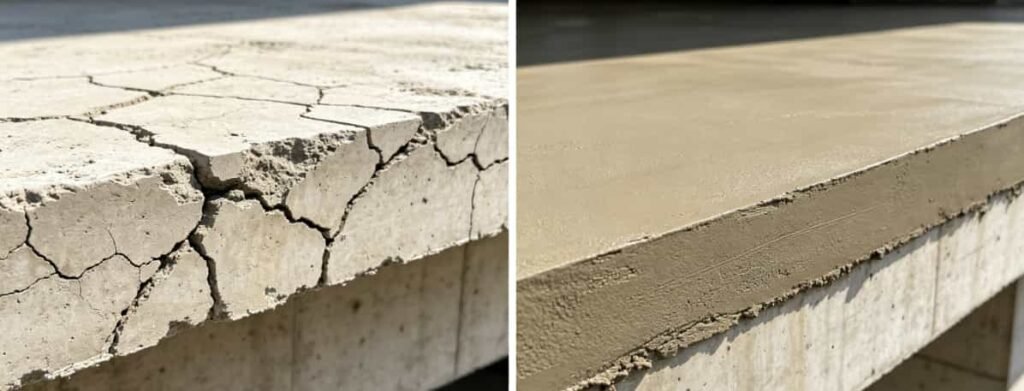
Most mortar cracks do not suddenly appear after curing.
On many construction sites, the problem starts much earlier — during mixing, spreading, exposure, or rapid moisture loss.
Installers usually notice the first warning signs through application behavior rather than laboratory data.
The adhesive may begin dragging under the trowel.
The surface may skin faster than expected in hot weather.
Bonding may initially appear acceptable, but hollow sounds or tile edge lifting can appear several days later.
By the time visible cracking develops, the mortar system has often already lost stability during installation.
Many manufacturers still focus heavily on strength or viscosity. In practice, however, crack resistance is closely linked to water retention, open time, and workability throughout the entire installation process.
These properties affect one another continuously under real site conditions.
Most contractors do not measure water retention directly.
They evaluate it through mortar behavior during application.
Once the mortar starts losing water too quickly, the entire installation process changes.
This is particularly common on:
In summer exterior tiling projects, surface skinning may begin only minutes after spreading.
Although the mortar still appears wet underneath, the surface may already have lost effective bonding capability.
At this stage, several issues often appear simultaneously:
Some installers compensate by adding extra water or remixing partially dried mortar during application. In many cases, this creates additional instability later during curing.
Cracking risk often starts increasing long before visible cracks appear.
For this reason, experienced formulators usually evaluate water retention under realistic installation conditions rather than relying only on laboratory percentages.
The same formulation can behave very differently depending on substrate absorption, weather conditions, and installation speed.
Laboratory conditions remain stable. Real job sites rarely do.
Technical datasheets typically describe open time as allowable working time.
On site, installers care about something simpler:
Will the adhesive still bond reliably after exposure?
This becomes especially important during large-format tile installation, where adhesives naturally remain exposed for longer periods before embedding.
In some projects, problems only become visible days later:
The adhesive surface may still feel workable, while actual bonding performance underneath has already declined significantly.
This is where many hidden failures begin.
Tile adhesive open time is therefore not simply a laboratory value. It directly affects hydration continuity and bonding stability during installation.
If installers spread oversized areas too quickly, or environmental conditions accelerate surface drying, effective open time may shorten much faster than expected.
This is one reason why field performance does not always match laboratory testing results.
Most contractors do not discuss rheology in technical terms.
However, they immediately recognize poor workability.
The mortar may:
Once this happens, installers naturally begin adjusting their application habits.
Some apply excessive pressure during embedding.
Others spread unevenly or repeatedly remix material during installation.
These adjustments often introduce additional stress into the mortar layer itself.
Uneven thickness, trapped air pockets, and unstable hydration can all contribute to localized shrinkage stress during curing.
On many job sites, installers identify cracking risks long before laboratory testing reveals abnormalities.
Good workability is not only about easier handling.
It also helps maintain more uniform material distribution throughout the bonding layer.
The mortar spreads more evenly, maintains comb lines more consistently, and supports more stable hydration during curing.
This is why many manufacturers now pay closer attention to cellulose ether and starch ether interaction instead of optimizing viscosity alone.
Improving a single laboratory parameter does not automatically improve mortar application stability.
Many discussions about mortar cracking focus only on curing stages.
In practice, shrinkage stress often begins developing much earlier.
Once moisture loss becomes uneven, internal stress starts building immediately within the mortar system.
If hydration changes too quickly, open time becomes unstable, or application thickness varies across the surface, stress concentration becomes increasingly difficult to control later.
By the time cracks become visible, the problem is often already irreversible.
For this reason, crack resistance should not be treated as an isolated property.
In many cases, it is simply the final result of how stable the long-term mortar application stability and early curing.
A balanced formulation helps to:
These differences become particularly visible during:
Visible failures may only appear several days or weeks later — when repair costs are already significantly higher.
Construction environments today place far greater demands on dry mix mortar systems than in the past.
Larger tiles, faster installation schedules, thinner bonding layers, and aggressive climate exposure all increase pressure on mortar formulation stability.
Under these conditions, increasing viscosity alone is no longer sufficient.
Modern formulations require balanced control over:
This is why some formulations perform well in laboratory testing but still develop instability under real site conditions.
Long-term installation stability depends on how consistently the mortar performs throughout the entire application and curing cycle — not on one isolated parameter alone.
Because bonding strength alone does not fully reflect internal stress development. Uneven hydration and early shrinkage stress may already be developing inside the mortar layer before visible failure appears.
High temperature, wind exposure, and absorbent substrates accelerate moisture evaporation. When moisture loss speeds up, shrinkage stress rises and increases cracking risk.
Not necessarily. Higher viscosity alone cannot guarantee stable water retention or balanced hydration, and may hurt spreading and workability.
Large-format tiles need longer exposure time. If the surface skins too fast, open time drops and weakens tile bonding and embedding quality.
Poor spreading creates uneven thickness, trapped air, and inconsistent pressure, turning into shrinkage points that crack after curing.
Cellulose ether stabilizes water retention and hydration, keeping mortar workability and open time steady for reliable anti-cracking performance.