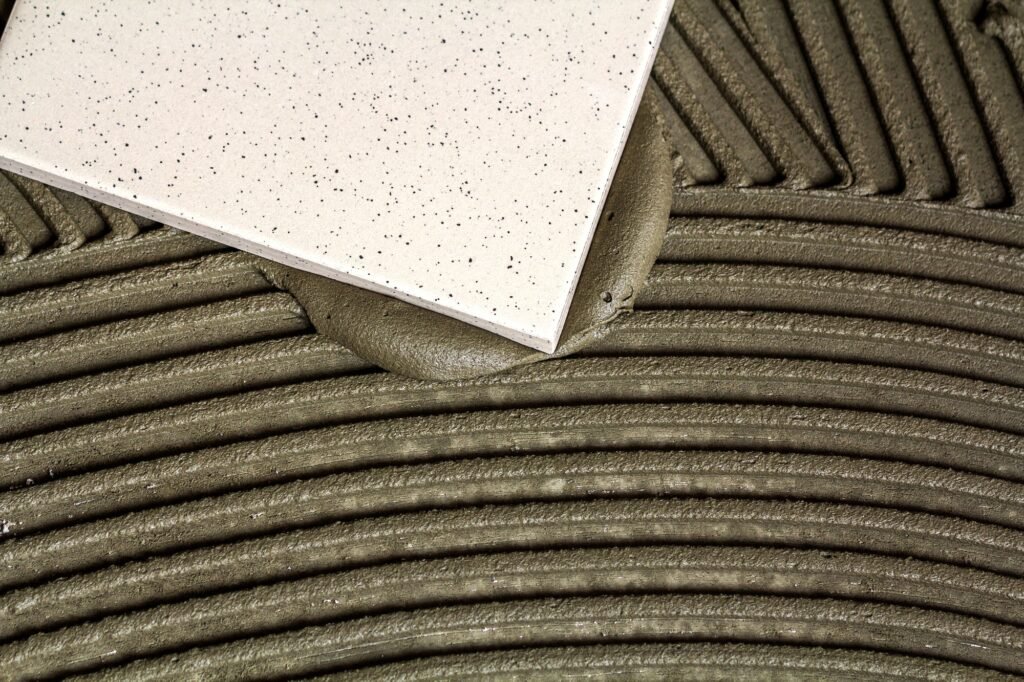
Tile Adhesive Composition: Ingredients, Additives and Formulation
Cement-based tile adhesive is made from cement, graded sand or mineral fillers, cellulose ether and, in polymer-modified products, redispersible polymer powder (RDP). Smaller amounts of functional additives adjust properties such as slip resistance, setting behaviour and air content. Water added during mixing activates the dry blend.
Each ingredient has a different job. Cement develops the mineral binder; sand and fillers control the mortar structure; cellulose ether manages water retention and fresh-mortar consistency; and polymer modification helps develop adhesion and accommodate stress. A successful formulation balances these functions for the intended tile, substrate and installation conditions.
This guide covers cementitious dry-mix tile adhesives. Ready-mixed dispersion adhesives and reaction-resin adhesives use different binder systems and should not be formulated from the same recipe.
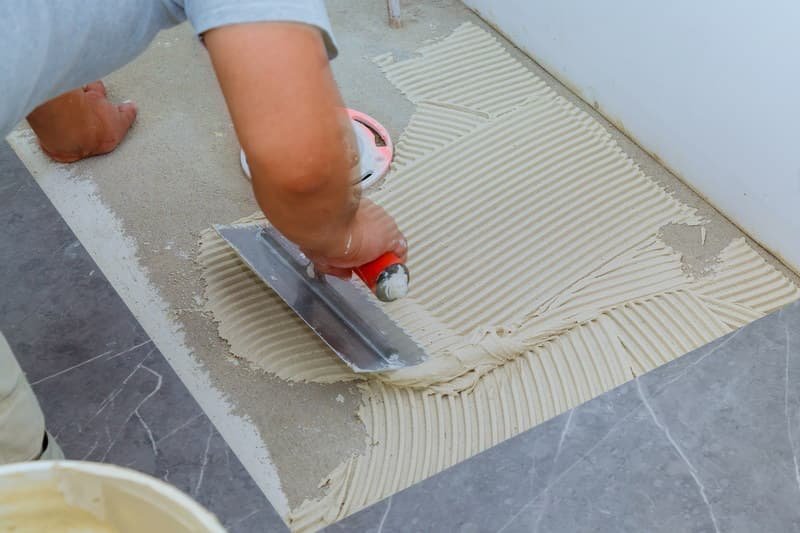
Tile adhesive composition must support both application and bonding performance.
Tile adhesive ingredients and their functions
| Ingredient | Main contribution | What the formulator should check |
|---|---|---|
| Portland cement or a specified cement blend | Hydraulic binding and strength development | Cement type, setting behaviour and compatibility with the additive package |
| Graded quartz sand | Aggregate skeleton and particle packing | Particle-size distribution, cleanliness and suitability for the intended adhesive bed |
| Mineral filler, such as calcium carbonate | Adjustment of packing and application consistency | Fineness and the resulting water demand |
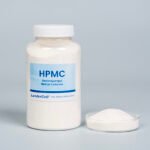
| HPMC or HEMC cellulose ether | Water retention and rheology control | Open time, spreading, ridge stability and tile wetting in the complete mortar |
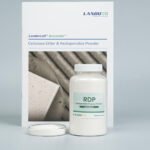
| Redispersible polymer powder | Polymer modification of adhesion and mechanical behaviour | Polymer grade, dosage and performance after the required conditioning |
| Optional functional additives | Targeted control of slip, air or setting | Whether the benefit introduces a trade-off elsewhere in the formulation |
Not every formulation needs every optional additive. Adding more components makes compatibility more important; it does not automatically produce a higher adhesive classification.
How the main ingredients work together
Cement: the hydraulic binder
Cement reacts with mixing water and develops a hardened mineral matrix. Its contribution depends on the cement itself and the conditions under which the mortar hydrates. A formulation therefore needs a defined cement source and grade, rather than a generic instruction to add “more cement.”
Treat a cement substitution as a formulation change. Compare the new and original materials at recorded water additions, then check application behaviour and adhesion. A satisfactory dry result alone does not establish performance after water immersion, heat ageing or freeze–thaw conditioning.
Sand and fillers: more than bulk material
Sand grading influences how particles pack and how the mortar spreads beneath the tile. Mineral fines can help adjust the consistency, but their effect must be evaluated with the actual sand and binder. Two blends with the same cement percentage can behave differently when their particle-size distributions differ.
Record sand grading, filler identity and filler fineness in the formulation sheet. If a new mineral blend requires more water to reach the same application consistency, that water change belongs in the comparison. Otherwise, the trial changes both the dry composition and the mixed mortar at once.
HPMC and HEMC: water retention and rheology
Cellulose ethers, including HPMC and HEMC, help control water retention and the consistency of fresh mortar. These functions support cement hydration and give installers a workable adhesive bed.
Their effectiveness depends on the grade and the complete formulation. For example, Dow describes a modified HEMC for cement-based tile adhesives that combines water retention, workability and rheology control. This supports evaluating these properties together rather than choosing a cellulose ether from viscosity alone.
For a grade comparison, examine mixing, spreading, ridge stability and transfer to the tile back. A mortar that holds sharp ridges but does not wet the tile adequately has not achieved the required balance. Use the supplier’s stated viscosity test method when comparing specifications; a viscosity number without its measurement conditions is incomplete.
The application-specific HPMC for tile adhesive page provides a route to grade selection once the mortar requirements are defined.
RDP: polymer modification
Redispersible polymer powder redistributes in water during mixing. As the mortar dries, its polymer phase can contribute to the adhesive bond and mechanical behaviour. WACKER describes dispersible polymer powders as supporting adhesion and flexibility while helping accommodate stresses between tile and substrate.
The practical question is which polymer grade and amount work in the intended system. A higher percentage is not proof of better performance under every exposure, and a polymer-modified recipe is not automatically a certified C2 or deformable adhesive. Test the finished mortar, including its conditioned adhesion results.
For product selection, see RDP for tile adhesive.
A published tile adhesive formulation example
A useful formulation example should show quantities, their basis and the limits of the evidence. WACKER patent EP2655280B1 includes the following base blend, described in that document as a C1 tile adhesive formulation. The percentages below are calculated from its 1,000 total parts by mass, excluding the optional dust-reducing addition.
| Raw material | Parts by mass | Percentage of dry base blend |
|---|---|---|
| Cement CEM I 42.5 N | 420 | 42.0% |
| Quartz sand | 480 | 48.0% |
| Calcium carbonate | 80 | 8.0% |
| Cellulose ether | 5 | 0.5% |
| Calcium formate | 5 | 0.5% |
| Specified VAE dispersible polymer powder | 10 | 1.0% |
| Total | 1,000 | 100.0% |
This is a documented example, not a LANDU production recipe or a universal dosage recommendation. The source specifies particular materials and investigates dust reduction. Substituting local cement, sand or additive grades requires new validation; copying the percentages does not establish the resulting adhesive’s classification.
Water is added separately and is not included in the dry percentages. A production formulation must specify its mixing-water range and verify performance within that range. Do not infer a water addition from this table.
C1 and C2 performance classes explain
For cementitious adhesives, C1 denotes normal adhesion performance and C2 denotes improved adhesion performance. Manufacturer guidance on EN 12004 identifies tensile adhesion thresholds of 0.5 N/mm² for C1 and 1.0 N/mm² for C2 under the relevant classification tests. The class is established by the finished product’s test results, not by its RDP percentage.
Additional designations describe separate properties: T identifies reduced slip, E extended open time, and S1/S2 deformability. Consequently, C2 alone does not establish extended open time or deformability. Check the complete designation and the declared applications.
For formulation development, this means defining the target before selecting additives. A product intended to meet C2TE has a different test brief from one also intended to meet S1. The applicable standard, conditioning procedures and product documentation should govern the final assessment.
Why porcelain tiles change the formulation brief
Low-absorption porcelain tiles make reliable interfacial bonding an important consideration. Polymer-modified cementitious adhesives are commonly used for these applications, but the appropriate product also depends on tile dimensions, substrate, exposure and expected movement.
Avoid the shortcut “porcelain means any C2 adhesive will work.” Confirm that the adhesive is declared suitable for the installation. A large-format wall tile, a heated floor and an exterior installation may introduce different requirements for coverage, slip, deformability or exposure resistance.
During development, evaluate both the fresh contact and the cured bond. Observe how well the mortar transfers to the tile back at the intended placement interval, then carry out the required adhesion tests. Good mortar consistency in the bucket does not establish reliable contact after the adhesive has been spread.
Optional additives: solve a defined problem
Starch ether, defoamers and setting-control additives can refine a formulation, but each should have a measurable purpose. The following is a trial-planning guide, not a prescription to include all of them.
| Trial objective | Additive to evaluate | Verification needed |
|---|---|---|
| Improve resistance to tile movement on a wall | Starch ether or a suitable rheology modifier | Slip performance alongside spreading and tile transfer |
| Control unwanted air in the mixed mortar | Compatible defoamer | Air content or fresh density, application behaviour and adhesion |
| Adjust setting or early strength | Suitable accelerator or retarder | Setting, working time and subsequent adhesion at the intended temperature |
| Modify water-repellent behaviour | An application-appropriate hydrophobic additive | Wetting and adhesion as well as the intended water-related property |
Do not use a water-repellent ingredient as a substitute for demonstrating conditioned adhesion. Similarly, reducing visible foam is not enough to prove that a defoamer improves the finished adhesive.

Evaluate the complete formulation with the intended raw materials and test conditions.
How to validate a tile adhesive formulation
Use the following sequence to make trial results comparable:
- Define the product brief. Record the intended adhesive designation, tile type, substrate, application thickness and exposure conditions.
- Fix the baseline materials. Record cement source, aggregate grading, filler specification and the identity and dosage of each additive.
- Control mixing. Weigh water, use a recorded mixing and resting procedure, and keep these conditions consistent across comparisons.
- Check application behaviour. Compare spreading, ridge stability, transfer to the tile back, slip and performance after the intended placement interval.
- Test the cured product. Use the applicable adhesion and conditioning procedures, plus the additional tests required by the target designation.
- Change one defined variable. Compare the revised blend with the baseline and retain the trial record. Recheck successful changes with the intended local raw materials before adoption.
When dry adhesion is satisfactory but a conditioned result fails, investigate the relevant failure mode before increasing polymer dosage. The separate guide on adhesive passing dry curing but failing water-immersion strength covers that diagnosis in more detail.
Choosing an additive package for local raw materials
Bring the formulation brief and trial results to the additive selection discussion. Useful inputs include the target classification, cement specification, sand grading, current dry recipe, mixing-water amount, application conditions and the test that needs improvement.
Contact LANDU with these details to discuss cellulose ether and polymer-powder options. The objective is an additive package that fits the complete mortar and its required performance. Retain successful baseline results so that any proposed change can be evaluated against them.
Frequently asked questions
Is tile adhesive just cement and sand?
Cement and sand are major constituents of cementitious dry-mix adhesives. Cellulose ether, polymer powder and selected functional additives provide further control over application and bonding properties. Dispersion and reaction-resin adhesives have different compositions.
Can HPMC replace RDP?
They serve different primary functions. HPMC is selected principally for water retention and rheology, while RDP supplies polymer modification. Treating them as interchangeable can leave an important performance requirement unaddressed.
How much polymer powder is needed for C2 tile adhesive?
There is no universal percentage that establishes C2 performance. The required grade and amount depend on the complete formulation. Confirm the classification through the applicable finished-product tests.
Is C2 tile adhesive always flexible?
C2 identifies improved adhesion. Where deformability is required, check for the appropriate S1 or S2 designation and the manufacturer’s declared suitability for the application.
What is the difference between open time and pot life?
Open time concerns the interval after spreading during which the adhesive can still achieve the required bond when a tile is placed. Pot life concerns the usability of the mixed material in its container. A workable mixture in the bucket may already have formed an unsuitable surface after spreading.