
Concrete technology · PCE selection guide
How Does PCE Improve Concrete Strength?Water Reduction Rate and Dosage Guide
Connect water reduction to the water-binder ratio, compare dosage on an active-solids basis and verify the result with fresh-concrete and strength tests.
Yes, a polycarboxylate ether superplasticizer can help concrete reach higher compressive strength. However, PCE does not act as a strength-generating binder. Its main contribution is to disperse cement particles and maintain the required workability with less mixing water.
When the water content falls while the binder content and target consistency remain controlled, the water-to-binder ratio decreases. The hardened paste can then develop a denser structure with fewer capillary pores. This is the main route by which a PCE superplasticizer can improve both early-age and later-age strength.
The practical question is therefore not simply, “How much PCE should be added?” A technical buyer or concrete producer should ask:
How much water can this PCE remove from our actual concrete while maintaining the specified slump, air content, setting behaviour and stability?
Quick Answer: What Water Reduction Rate Can PCE Achieve?
Modern PCE-based high-range water reducers commonly deliver approximately 15% to 40% water reduction, depending on the product, dosage and concrete system. Some high-water-reduction grades are specified at 25% or more, while selected products may reach the upper part of the range under compatible test conditions.
These figures must be interpreted correctly:
- ASTM C494 Type F and Type G high-range water reducers are evaluated against a reference concrete and require at least 12% water reduction under the standard test framework.
- European industry guidance describes approximately 15% to 40% as a typical operating range for superplasticisers.
- A product value such as 25%, 34% or 40% applies to the stated test method and materials. It is not an automatic result in every local cement, aggregate or supplementary cementitious material system.
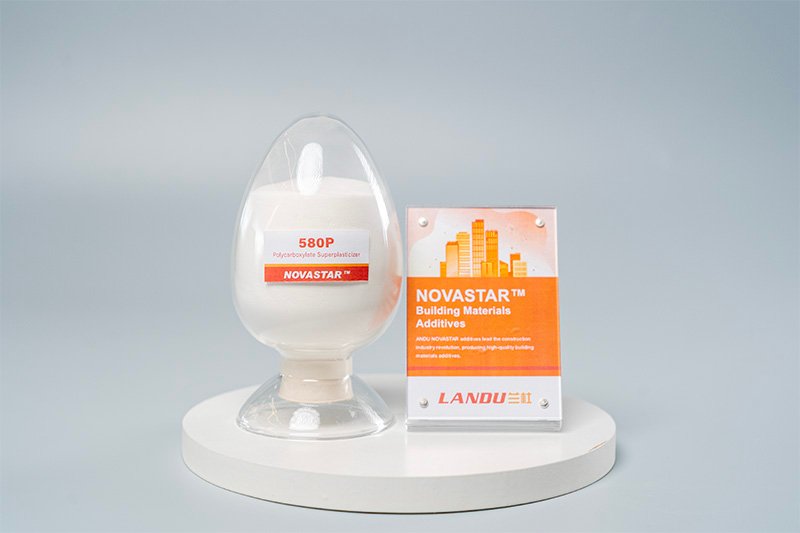
LANDU's PCE range illustrates this grade-specific approach. The NOVASTAR PCE product and application page lists powder grades for different cement systems, while PCE 580P is positioned for high water reduction in applications such as precast concrete, self-levelling systems and UHPC.

How Does PCE Increase Concrete Strength?
1. PCE Disperses Flocculated Cement Particles
Without an effective dispersant, cement particles tend to form agglomerates that trap part of the mixing water. PCE adsorbs on particle surfaces, and its comb-shaped molecular structure creates steric separation between particles.
Better dispersion releases trapped water and improves flow. The formulator can then reduce the total water content without losing the required consistency.
2. Lower Water Demand Reduces the Water-Binder Ratio
Consider a concrete containing 400 kg/m³ of total binder:
- At 200 kg/m³ water, the water-binder ratio is 0.50.
- At 160 kg/m³ water, the water-binder ratio is 0.40.
If a compatible PCE maintains the target slump after this water reduction, the lower water-binder ratio can support higher compressive strength and lower permeability. The result still depends on adequate mixing, placing, compaction and curing.
3. Improved Workability Supports Better Compaction
PCE can also help concrete flow around reinforcement and into complex formwork. Better placement can reduce entrapped voids when the mixture remains cohesive.
This benefit has a limit. Excessive dosage or an unsuitable grade may cause segregation, bleeding, delayed setting or unstable air content. A very fluid mix is not automatically a strong mix.
Is a Higher Water Reduction Rate Always Better?
No. The correct water reduction rate is the highest useful reduction that still satisfies the complete concrete specification.
| Check | Why it matters to strength |
|---|---|
| Target slump or flow | Confirms that water was reduced without losing required placement performance |
| Slump retention | Prevents water being added later at the jobsite |
| Air content | Excess air can reduce compressive strength, although specified entrained air may be required for durability |
| Bleeding and segregation | Show whether the paste and aggregate system remains stable |
| Setting time | Determines finishing, demoulding and production timing |
| 1-, 3-, 7- and 28-day strength | Separates early-strength effects from later strength development |
A PCE that gives 35% water reduction but causes unacceptable slump loss may be less suitable than a grade that gives 28% reduction with stable transport and placement performance. For ready-mix concrete, a slump-retention PCE may be more valuable than the highest initial water reduction. For precast production, early strength and predictable setting may take priority.
What PCE Dosage Should You Use?
There is no single correct percentage for every PCE product. Dosage must be read together with the product form, active solids and calculation basis.
| Product form | Suitable starting approach | Important calculation basis |
|---|---|---|
| Powder PCE | Screen within the supplier's TDS range; some high-water-reduction powders start around 0.1%–0.3% | Confirm whether the percentage is based on binder or total dry material |
| Liquid PCE mother liquor | Convert the required active polymer into liquid mass using the measured solid content | Do not compare liquid percentages without comparing solids |
| Finished liquid admixture | Follow the product TDS and optimise around the recommended range | The formulation may contain water, retention components, defoamer or other modifiers |
| Early-strength or accelerating system | Select against required demoulding time and early strength | Check setting time, cement compatibility and relevant project restrictions |
The frequently quoted 1.5%–2.0% of binder may be an appropriate trial range for a particular finished liquid admixture, but it is not a universal PCE dosage. It should not be transferred directly to a powder grade or a mother liquor with a different solids content.
Dosage Calculation Example
Assume the concrete contains 400 kg/m³ of binder and the target active PCE dosage is 0.20% by mass of binder:
Active PCE required = 400 × 0.20% = 0.80 kg/m³
If the liquid mother liquor contains 40% active solids:
Liquid mother liquor required = 0.80 ÷ 0.40 = 2.00 kg/m³
This equals 0.50% liquid product by mass of binder. A different solid content produces a different liquid dosage even when the active polymer dosage is unchanged.
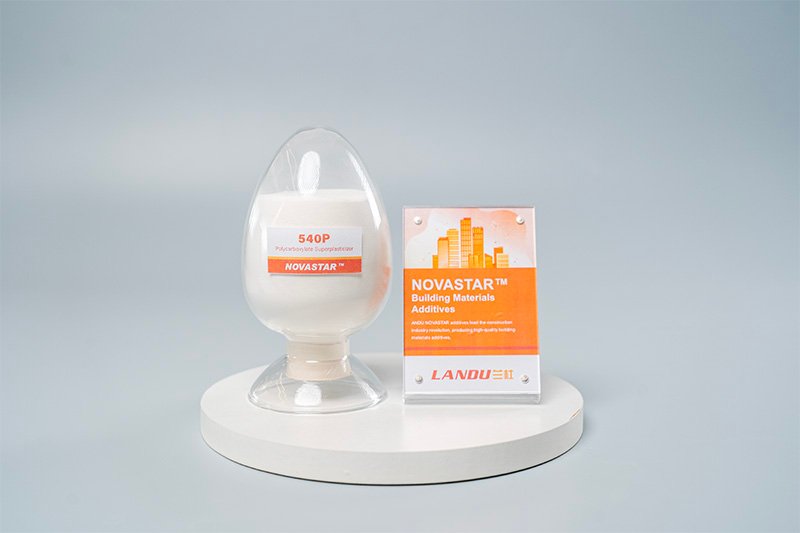
For dry-mix mortar or specialised powder systems, use the dosage basis stated on the relevant TDS. For example, PCE 540P is formulated for sulphoaluminate cement systems and its use range should not be copied directly into ordinary ready-mix concrete.
Which PCE Type Should You Choose for Higher Strength?
Choose High Water Reduction When the Main Goal Is Lower Water-Binder Ratio
Use this route when the mixture must achieve higher compressive strength, reduced permeability or a denser hardened structure while maintaining practical workability.
The main purchasing checks are:
- declared water reduction under a stated method;
- recommended dosage and dosage basis;
- active solids or active component content;
- compatibility with the proposed cement and mineral additions;
- air entrainment, bleeding and setting behaviour;
- batch consistency.
Choose Slump Retention When Transport Time Controls the Mix
For ready-mix concrete, a rapid loss of consistency may lead operators to add water on site. That additional water can cancel the strength benefit created by the PCE.
A retention grade or blended system should therefore be compared at the actual delivery time and temperature, not only immediately after mixing.
Choose an Early-Strength System When Demoulding Time Is the Constraint
Precast elements often need sufficient early strength for demoulding, lifting or prestressing. A PCE selected for low water demand and predictable early hydration can help, but early strength must be verified at the required age.
If an accelerator is also used, the combined system must be checked for setting time, final strength, shrinkage, reinforcement compatibility and temperature sensitivity. LANDU's guide to common PCE superplasticizer problems explains how slump loss, stickiness, cement compatibility and clay sensitivity change the grade-selection decision.
Why Does the Same PCE Dosage Produce Different Results?
PCE demand and water reduction can change when any of the following changes:
- cement composition, fineness or sulphate balance;
- limestone, slag, fly ash, silica fume or other additions;
- clay and fines in the sand;
- aggregate grading and moisture;
- concrete temperature;
- mixing sequence and mixing energy;
- other admixtures, including defoamers, retarders, accelerators and air-entraining agents;
- elapsed time before testing.
Clay-contaminated sand is especially important because some fines can consume or interfere with the dispersing action of PCE. Increasing dosage without checking the aggregate may give poor economy and unstable performance.
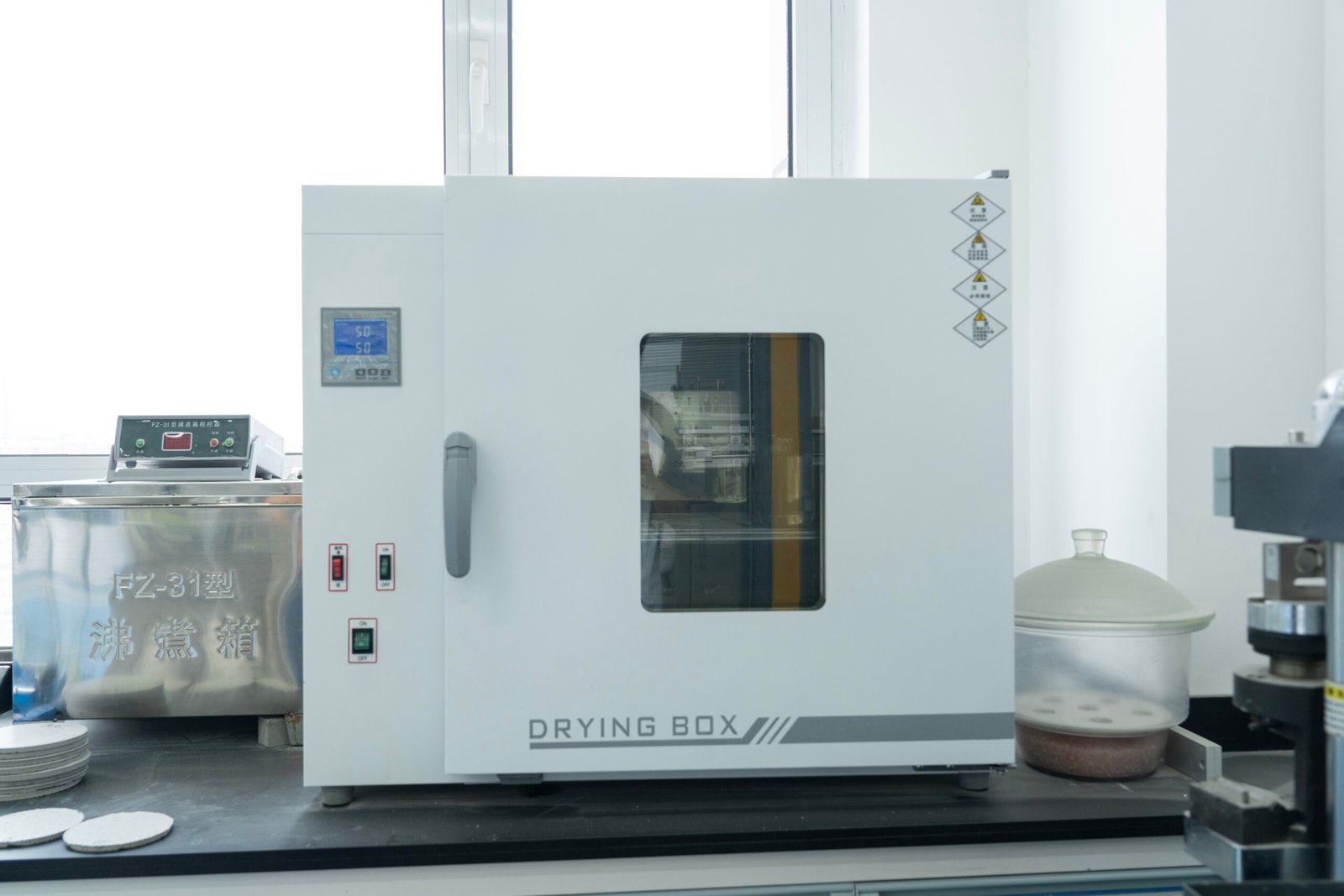
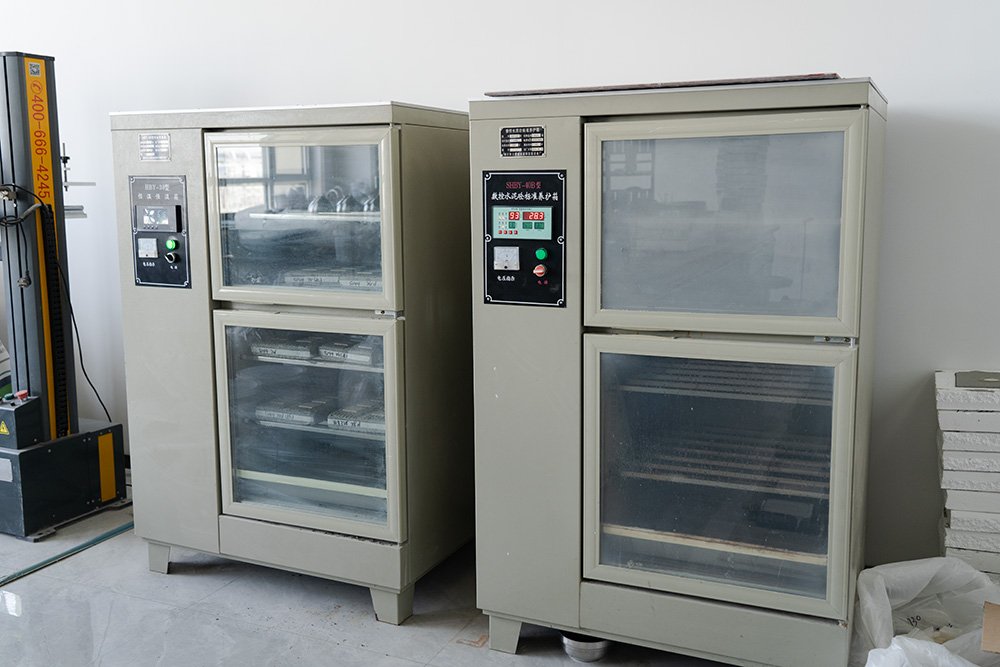
How Should You Run a PCE Strength Trial?
Use the actual project cement, mineral additions, aggregates and mixing water. Keep the binder content and target consistency fixed, then compare a control with at least three PCE dosage levels.
- Record the control mix. Measure water content, slump or flow, air content, temperature and setting behaviour without changing several variables at once.
- Set low, middle and high trial dosages. Base them on the supplier's TDS and calculate all liquid products on an active-solids basis.
- Reduce water to the same target consistency. Do not compare strength at different slumps without explaining the difference.
- Calculate the achieved water reduction. Use:
(control water − test water) ÷ control water × 100%. - Check fresh-concrete stability. Record slump retention, air, bleeding, segregation, pumpability or mould filling as relevant.
- Measure strength at useful ages. For general concrete, 3-, 7- and 28-day results are typical. Add 1-day or earlier testing when precast demoulding controls production.
- Repeat around the best result. A useful dosage window is more reliable than a single optimum point.
For application matching beyond normal concrete, review LANDU's construction additive applications before transferring a PCE grade between self-levelling mortar, precast concrete, UHPC and ready-mix concrete.
Common Mistakes When Comparing PCE Products
- Comparing two liquid dosages without normalising their solid content.
- Treating a laboratory water reduction value as a guaranteed field result.
- Increasing dosage after slump loss without checking temperature, time and cement compatibility.
- Ignoring air content when interpreting compressive-strength results.
- Selecting only by initial flow and overlooking bleeding, segregation or setting delay.
- Assuming an early-strength grade will automatically improve 28-day strength.
- Copying a dosage from one cement or aggregate source into another mixture.
What Information Should You Send to a PCE Supplier?
To receive a useful grade and dosage recommendation, provide:
- cement type, source and recent test data;
- supplementary cementitious materials and replacement levels;
- binder content and current water-binder ratio;
- aggregate grading, moisture and available fines or clay data;
- target slump or flow and required retention time;
- concrete temperature and transport time;
- required strength ages and values;
- current admixture type, dosage and solid content;
- observations of bleeding, segregation, air or setting problems.
Conclusion
PCE improves concrete strength mainly by allowing the mix designer to reduce water while preserving the required workability. A typical high-range water-reduction window is approximately 15%–40%, but the result must be verified with the local cement, additions, aggregates and temperature.
Do not select PCE from a water-reduction claim alone. Compare dosage on an active-solids basis, hold the target consistency constant, monitor air and stability, and test strength at the ages that matter to production and the project specification.
If you send LANDU your concrete composition, target slump, retention time and strength requirements, the technical team can recommend a suitable PCE grade and a controlled trial range. Request PCE selection and formulation support.