
This guide is for formulators who specify HPMC for gypsum plaster, gypsum putty, joint compound or gypsum self-leveling, and for buyers comparing a gypsum special grade HPMC against a cement grade. It explains what makes a gypsum grade different, which viscosity and dosage suit each product, which parameters belong on the specification, and how to run a comparison trial.
It does not explain how additives work in gypsum, how hand and machine plaster differ or how raw gypsum quality shifts results; the gypsum plaster application page covers those. This page stays on grade specification and selection.
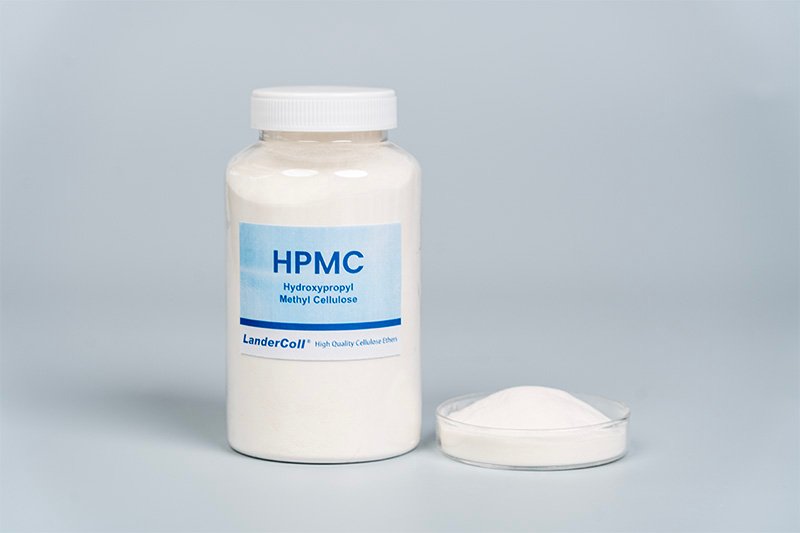
What makes a gypsum grade cellulose ether different from a cement grade
Cement mortar has a pore solution at pH 12.5–13; a gypsum paste sits near neutral, typically pH 6–8 unless lime is added. That difference changes how the cellulose ether must be made. Most mortar-grade HPMC and MHEC are surface-treated with glyoxal so the powder disperses before it thickens. The treatment hydrolyses quickly in alkaline water, so in cement the ether dissolves within a minute. In near-neutral gypsum it can hold back viscosity for several minutes, long enough for an absorbent wall to pull water out of the plaster first.
Gypsum grades therefore use lighter or no delayed-solubility treatment, finer particle size, or both, so that viscosity builds within the mixing time. For machine plaster this matters most: the mixing pump combines powder and water in seconds and delivers to the hose immediately.
Two more differences follow from gypsum’s fast set. The ether must not interfere unpredictably with the retarder, because both adsorb on gypsum crystals, and its own small retarding effect must be stable from lot to lot. Thermal stability, which dominates cement-grade selection in hot climates, matters less because a gypsum paste never heats up. A modified HEMC for gypsum-based plaster or a gypsum additive HPMC is usually a mortar grade re-engineered on these points, not a different polymer.
The jobs HPMC and MHEC do in gypsum plaster
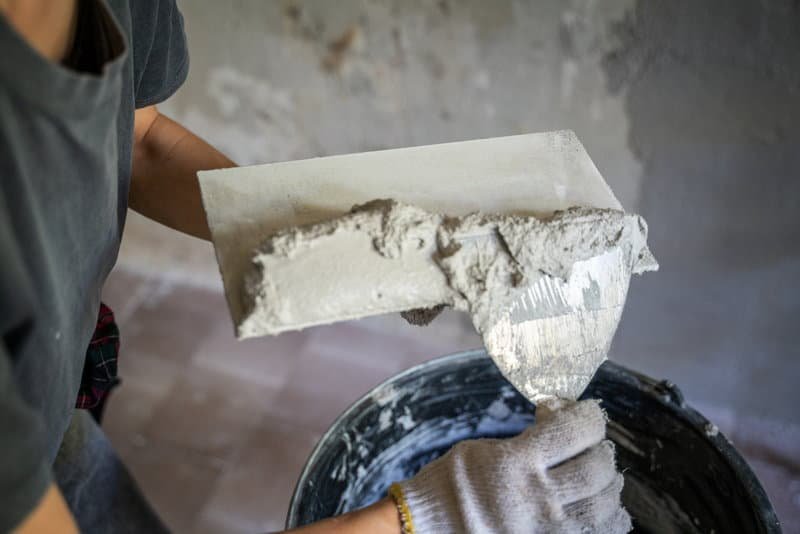
Cellulose ether in gypsum-based products does five things, and the grade decision depends on which matters most for your product.
- Water retention against absorbent substrates such as AAC and brick, so hydration completes and the surface does not powder; how water retention works in dry-mix mortar applies to gypsum too.
- Workability and a smoothing window: the plaster stays open long enough to flatten and felt.
- Sag resistance for thick layers, for example 10–20 mm machine plaster in one pass.
- Cohesion for pumping and spraying, with less segregation and splash.
- Surface finish: a dense, closed surface after felting and less tearing under the trowel.
HPMC or MHEC for gypsum: typical practice
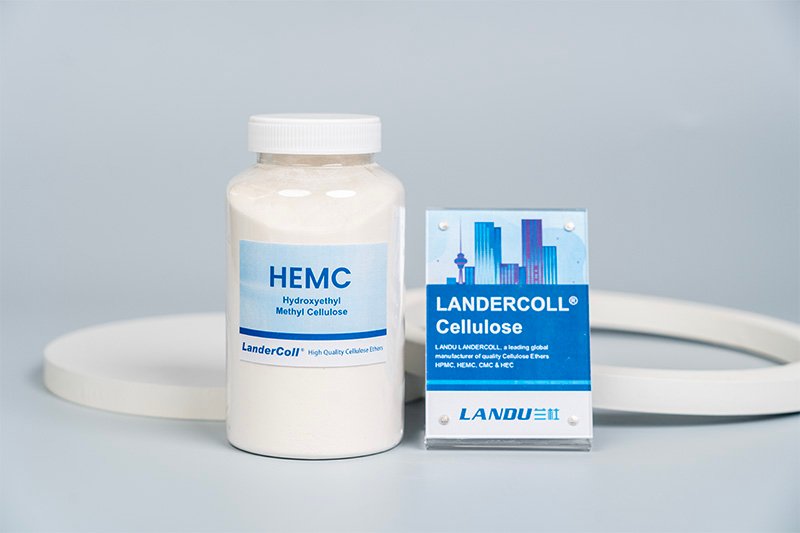
Both chemistries are used in gypsum. Typical practice chooses MHEC for plaster where thick layers, machine application or warm conditions dominate, because many MHEC grades have a higher thermal gel point and hold a more stable paste under shear. HPMC is common in hand plaster, gypsum skim and joint compound, where smooth trowel feel and a fine finish count. LANDU’s gypsum-oriented LANDERCOLL grades (ME3570-G at 35,000–45,000 mPa·s and ME4080-G at 30,000–40,000 mPa·s, Brookfield 2 % solution, 20 °C, both unmodified by surface treatment) are HEMC-based for the same reasons, but neither chemistry wins by name. For the general comparison see HPMC vs HEMC (MHEC) for construction mortars; for gypsum, test both in your own binder and retarder system.
Viscosity and dosage by gypsum product type
Viscosity is the first filter. Higher viscosity gives more water retention and sag resistance per gram but stickier trowelling and more air; lower viscosity gives smoother flow and easier pumping. The classes below are typical starting points; confirm every figure on your own gypsum.
| Gypsum product | Main cellulose ether job | Suggested type | Typical viscosity class (2 % solution, 20 °C, mPa·s) | Typical dosage (% of dry mix) |
|---|---|---|---|---|
| Hand plaster (base and one-coat) | Water retention, open time, trowel feel | HPMC or MHEC | 30,000–100,000 | 0.15–0.3 |
| Machine-sprayed plaster | Pumpability, sag resistance in thick layers | MHEC, modified HPMC | 30,000–75,000 | 0.15–0.3 |
| Gypsum skim coat and putty | Water retention in thin layers, smooth finish | HPMC | 60,000–100,000 | 0.3–0.5 |
| Joint compound (setting type, powder) | Water retention, slip, sag | HPMC | 40,000–75,000 | 0.3–0.6 |
| Gypsum bonding adhesive (boards, blocks) | Sag resistance, open time | HPMC or MHEC | 60,000–100,000 | 0.3–0.5 |
| Gypsum self-leveling screed | Stabilise flow, limit bleeding without trapping air | Low-viscosity HPMC | 400–5,000 | 0.03–0.1 |
One note on HPMC viscosity for gypsum plaster: a finer, faster-dissolving powder gives more effective viscosity in the first minutes than a coarser powder of nominally higher grade, so specify both. The LANDU grades whose data sheets list gypsum plasters and renders sit in the 30,000–60,000 mPa·s Brookfield band (HPMC K100, HEMC EM60, EM100, ME3570-G and ME4080-G), with K75 and EM80 above it; the band in the table is the wider industry range.
Interactions that change the right grade

Retarder. Cellulose ether adds a few minutes of set delay and changes paste rheology, so the gypsum retarder dose is set with the ether in the mix and re-checked whenever the grade changes.
Air. Methyl cellulose ethers are mildly surface-active and entrain air. In machine plaster some air helps pumping and yield; in skim coat, putty and self-leveling it causes pinholes and lower strength, so a powder defoamer is dosed alongside. Higher viscosity and finer powder generally entrain more air.
Starch ether. Hydroxypropyl starch ether at 0.02–0.1 % adds sag resistance and trowel release, allowing a lower cellulose ether dose or a lower viscosity class.
Redispersible polymer powder. In gypsum adhesives and skim coats, the polymer’s protective colloid adds viscosity and the polymer film adds adhesion; reduce cellulose ether viscosity before dosing more RDP.
Gypsum source. FGD gypsum is finer and has a higher water demand than most natural gypsum, so it often needs a slightly higher ether dose or viscosity class at the same water content. Lime additions raise pH and speed the dissolution of treated grades.
Parameters to specify when ordering cellulose ether for gypsum
A viscosity number alone does not define a gypsum grade. Put these on the specification and ask for them on the certificate of analysis:
- Viscosity with method: 2 % aqueous solution, Brookfield RV (spindle and speed) or NDJ rotational viscometer, 20 °C. The two methods are not interchangeable: LANDU data sheets that quote both show the NDJ-1 figure at roughly 1.8–2 times the Brookfield RV figure for the same grade (K100: 85,000–110,000 NDJ-1 against 45,000–60,000 Brookfield). Höppler or Ubbelohde values are not comparable either.
- Substitution: methoxyl and hydroxypropoxyl (HPMC) or hydroxyethoxyl (MHEC) content, or DS/MS. LANDU HPMC sheets state 19–24 % methoxyl and 4–12 % hydroxypropoxyl; the gypsum HEMC grades state the MS/DS pair. These control gel temperature, water retention and surface activity.
- Particle size, for example percent passing 80 mesh (180 µm) or 100 mesh (150 µm); LANDU grades specify ≥ 90 % or 100 % through 80 mesh. Finer dissolves faster; too fine dusts and lumps.
- Moisture (commonly ≤ 5–6 %; LANDU sheets state ≤ 6 %) and ash or residue on ignition (≤ 5 % on most LANDU grades), a measure of process salt.
- Dissolution or thickening time: time to reach a stated share of final viscosity in 20 °C water, and whether the grade is surface-treated. LANDU sheets state this as “delayed solubility: yes/no” and “consistency development: very fast/slow”.
- Gel temperature: LANDU HPMC sheets quote 60–90 °C or 70–90 °C depending on grade; MHEC grades generally gel higher, which is why they are preferred where the paste warms under shear or in hot weather.
- Water retention value and method. The filter-paper method brings fresh mix into contact with dry filter papers for a fixed time, usually 5 minutes, through a separating gauze; the water the papers absorb is weighed and water retention = 100 × (1 − water lost / water in the mix). DIN 18555-7 and EN 1015-8 describe this for mortar; many gypsum labs adopt it, so state the reference plaster and water ratio used.
- Lot-to-lot tolerance on viscosity and dissolution time, and the number of lots behind it.
When you request LANDERCOLL HPMC grades such as K100 or K75 (both list gypsum plasters and renders on their data sheets), or the HEMC grades EM60, EM80, EM100, ME3570-G and ME4080-G, ask for a TDS with these parameters, not the viscosity label alone.
How to run a comparison trial
- Fix the base: one gypsum lot, one filler, the current retarder dose, 20–23 °C.
- Set water once: determine the water/plaster ratio for standard consistency with your reference grade (EN 13279-2) and keep it fixed for every candidate, recording the spread each gives.
- Measure fresh properties: water retention by the filter-paper method, initial and final set by the knife or Vicat cone method, sag on a vertical AAC block at 15–20 mm, and the time until felting is possible.
- Rate application: trowel release, surface closure after felting, pinholes.
- Test hardened properties per EN 13279-2: flexural and compressive strength on prisms dried at 40 °C, surface hardness and, for bonding products, adhesion.
- Repeat the two best candidates at 30–35 °C and, for machine plaster, through the actual pump.
- Decide on cost per square metre at equal performance, not price per kilogram.
Frequently asked questions
What HPMC viscosity is right for gypsum plaster?
Most hand and machine plasters use 30,000–100,000 mPa·s (Brookfield, 2 % solution, 20 °C), with machine grades at the lower end for pumpability; LANDU’s gypsum-listed grades sit at 30,000–60,000. Skim coat and putty sit at 60,000–100,000, and gypsum self-leveling screeds use low-viscosity grades of 400–5,000. Treat these as starting classes and confirm by trial.
How much HPMC goes into gypsum plaster?
Typical dosage is 0.15–0.3 % by weight of dry mix for plaster, 0.3–0.5 % for skim coat, putty and bonding adhesive, and 0.03–0.1 % for self-leveling screeds. Absorbent substrates, FGD gypsum and longer open-time targets push the dose up.
Is MHEC better than HPMC for gypsum mortar?
Not by name. MHEC for gypsum mortar is often preferred for machine plaster and thick layers because of its higher gel point and stable paste under shear; HPMC is common in hand plaster, skim and joint compound. Test both in your own gypsum and retarder system.
What is a gypsum special grade HPMC?
A gypsum special grade HPMC is a mortar grade adapted to gypsum’s near-neutral pH and fast set: lighter or no delayed-solubility treatment, finer particle size for fast viscosity build, and a small, stable effect on setting time so retarder dosing stays predictable. Ask for dissolution time and setting-time shift on the TDS.
Can I use a cement-grade HPMC in gypsum products?
Often, but check dissolution. A heavily surface-treated cement grade can thicken too late in near-neutral gypsum, so water is lost to the substrate before the ether works. If the lump-free dissolution time in 20 °C water exceeds your mixing-to-application time, choose a gypsum grade.
Is there an eco-friendly HPMC for gypsum products?
Cellulose ether is made from refined cotton linter or wood pulp, is used at a few tenths of a percent and adds no solvent or VOC to a dry mix. Those are facts, not a label. For documentation, ask the supplier for the safety data sheet and any environmental product data.
Related LANDU resources
- LANDERCOLL HPMC (hydroxypropyl methylcellulose) product page and grades
- LANDERCOLL MHEC (hydroxyethyl methyl cellulose) for gypsum and cement mortars
- The four key gypsum plaster additives: HPMC, HEMC, RDP and retarder
- Gypsum applications hub: plaster, putty, board compounds and self-leveling
Send your product type, gypsum source and target open time to LANDU for a grade recommendation and a trial sample.