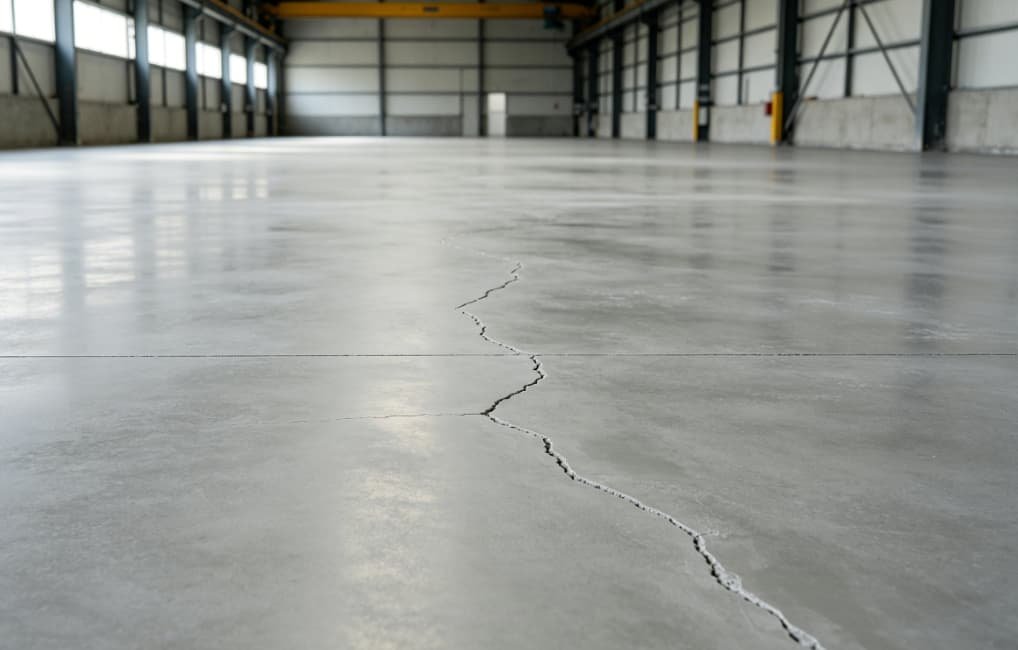
Some self-leveling floors look completely stable on the day of installation, then begin showing fine cracks the next morning after curing appears finished.
This is one of the most frustrating problems in flooring applications because the failure often starts before the cracks become visible.
In many cases, the mortar spreads well, levels properly, and even develops acceptable early strength. The cracking only begins later, once internal moisture loss, shrinkage stress, and curing speed stop staying balanced across the floor.
That is why post-curing cracks are often difficult to diagnose from surface appearance alone.
For flooring manufacturers and contractors, understanding why self-leveling compounds crack after curing usually means looking at what happened during the first 24 hours — not just after the floor hardened.
One of the most common reasons cracks appear after curing is uneven drying through the thickness of the floor.
The surface layer loses moisture first. Meanwhile, the lower section of the mortar may still be hydrating and developing internal structure underneath.
As the upper layer stiffens, shrinkage stress starts building inside the system.
This becomes more visible in:
On some projects, cracking first appears around doorways or thinner edges where moisture escapes faster.
The floor may already feel hard underfoot while internal stress is still increasing underneath the surface.
Many self-leveling compounds remain visually stable during initial curing.
The problem usually starts later, once the mortar begins losing moisture more aggressively overnight or after ventilation increases on site.
This is why cracks often appear:
In practice, the floor may not actually be “finished curing” when the cracking starts.
Hydration, moisture movement, and shrinkage are still evolving during the early curing stage, especially in cement-rich systems with rapid surface hardening.
Some formulations become rigid too early while internal stress is still developing.
Once the floor loses enough flexibility, fine cracks can begin opening across weaker areas of the surface.
Additional mixing water may temporarily improve flowability during installation, but it often creates more instability later during drying.
This is particularly common in pump-applied self-leveling systems where installers increase water to maintain easier flow across large areas.
The floor may initially appear smooth and workable.
After curing, however, the structure becomes more vulnerable to:
The problem is usually not visible during pouring itself.
Many floors only begin showing crack patterns after moisture starts leaving the mortar unevenly across different curing zones.
Areas near airflow or direct heat exposure typically crack first.
Some self-leveling compounds develop high early hardness but tolerate very little internal movement during curing.
This becomes especially noticeable in:
A rigid floor may perform well in compressive strength testing while still becoming vulnerable to brittle fracture during drying.
Modern flooring systems increasingly rely on polymer-modified flooring systems to improve dimensional stability during curing rather than simply increasing hardness.
Flexible polymer systems for flooring help reduce stress concentration as the mortar shrinks and hardens.
Within LANDU self-leveling additive systems, polymer selection is typically adjusted according to curing behavior in self-leveling compounds, drying conditions, and flexibility requirements under practical flooring applications.
Not all post-curing cracks originate inside the mortar itself.
Concrete movement, uneven absorption, or unstable substrate conditions may begin transferring stress upward after the self-leveling layer has already hardened.
This is common on renovation projects where older substrates contain hidden movement or inconsistent moisture behavior.
Typical signs include:
Some floors remain stable during installation but begin cracking later once the substrate starts responding to temperature change or moisture movement underneath.
This is one reason experienced flooring contractors pay close attention to substrate preparation before pouring begins.
Once stress starts transferring upward from the base layer, post-curing cracking becomes much more difficult to control.
Drying conditions on site can change dramatically within just a few hours after installation.
A floor poured in stable conditions during the afternoon may suddenly experience:
This changes how moisture leaves the surface.
Some areas dry faster than others, creating uneven shrinkage across the floor.
Large open spaces are particularly sensitive because airflow rarely stays consistent throughout the entire curing area.
In practice, post-curing cracks often reflect environmental instability more than obvious formulation failure.
Self-leveling compounds rarely crack after curing because of one single issue.
More often, cracking develops when several smaller factors begin interacting during the early curing stage:
This is why some floors remain stable in controlled testing but behave differently under real installation conditions.
Long-term curing stability depends on how well the formulation handles stress while moisture, temperature, and hydration are still changing inside the floor.
That balance is what usually determines whether a Cracking in self-leveling compounds stays stable after curing or begins developing delayed cracking later.
Many cracks appear after moisture loss accelerates during early curing. The floor may look hardened, but shrinkage stress and hydration are still developing internally.
Yes. Rapid surface drying often creates uneven shrinkage between the upper and lower sections of the mortar, especially in thin pours or heated environments.
Edges, doorways, and thinner sections usually lose moisture faster than the rest of the floor. This creates localized stress concentration during curing.
Yes. Higher water content can increase drying shrinkage and weaken the cured structure, making the floor more sensitive to cracking later.
Yes. Existing movement, uneven absorption, or instability in the substrate can transfer stress upward into the self-leveling layer after curing begins.