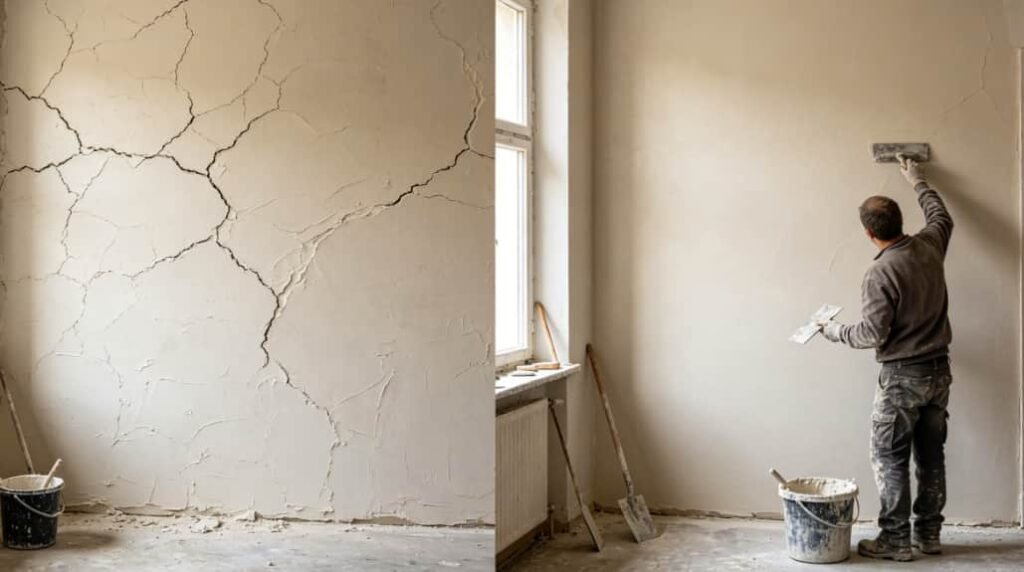
Cracking in self-leveling compounds usually starts long before cracks become visible on the surface.
Many floors look stable during pouring and initial curing, then begin developing hairline cracks a day later near thinner sections, doorways, or fast-drying areas. In most cases, the problem is not caused by one defective raw material. It starts when water loss, shrinkage stress, and formulation flexibility stop staying in balance during curing.
This is why some self-leveling mortars perform well in laboratory flow tests but become difficult to control on real job sites.
For manufacturers, crack prevention is less about maximizing strength and more about keeping the system stable while the floor is drying, hardening, and releasing internal stress.
On site, cracking frequently begins with water adjustment.
Installers sometimes increase mixing water to improve flow or pumping behavior, especially in warmer conditions or large-area pours. The mortar may initially spread faster, but the cured structure often becomes more sensitive to shrinkage and surface tension during drying.
The first warning signs are not always major cracks.
In many floors, edge cracking, surface dusting, or slight curling appears first.
This is especially common in:
In practice, stable self-leveling mortar flowability usually comes from rheology control and particle distribution rather than additional water.
Some formulations look fluid during application but lose stability once moisture starts leaving the surface too quickly.
Higher compressive strength does not automatically improve crack resistance.
Some self-leveling systems become too rigid during curing, particularly in thin pours or fast drying conditions. Once shrinkage stress starts concentrating, even small substrate movement or thermal variation can begin opening surface cracks.
This becomes more visible in:
Floors with insufficient flexibility often crack earlier around weaker sections or transitions between different substrate conditions.
This is why polymer selection matters beyond simple strength improvement.
Flexible polymer systems for flooring help the mortar tolerate internal movement during curing instead of allowing stress to concentrate into brittle fracture zones.
In modern polymer-modified self-leveling formulations, dimensional stability is often more important than pushing compressive strength to the highest possible level.
Within LANDU self-leveling additive systems, polymer compatibility is typically adjusted according to curing speed, flow behavior, and deformation tolerance under practical flooring conditions.
Many self-leveling cracks begin while cement hydration is still developing.
When the surface dries faster than the lower section of the mortar, internal tension starts building between layers. The floor may still appear stable visually, but stress is already concentrating inside the system.
This is common near:
Some floors remain intact overnight, then begin showing fine cracking the following morning after rapid moisture loss.
Others become overly dense at the surface while the lower section is still stabilizing underneath.
In practice, excessive drying speed is often more damaging than slightly slower curing.
The goal is not maximum water retention or the fastest possible hardening speed. What matters is maintaining predictable curing behavior throughout the floor.
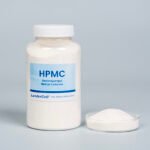
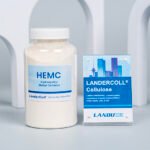
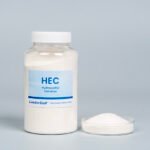
In self-leveling compounds, cellulose ether influences much more than water retention alone.
Overly high viscosity can reduce flow and increase air entrapment during mixing. At the same time, insufficient water control may create uneven hydration and unstable drying behavior.
This becomes especially noticeable in pump-applied self-leveling systems where flow consistency must remain stable throughout application.
For self-leveling flooring formulations, cellulose ether for self-leveling mortar selection usually needs to stay balanced with:
Many modern systems now prefer lower-viscosity cellulose ether grades because they allow better flow control without making the mortar excessively heavy or sticky during placement.
LANDU self-leveling additive formulations are typically designed around this balance between rheology stability, curing control, and practical application performance.
Not every crack is generated inside the mortar itself.
Weak substrates, inconsistent absorption, poor primer penetration, or movement in the concrete base can transfer stress directly upward into the leveling layer.
On renovation projects, cracks often begin appearing around existing joints, repaired sections, or areas with uneven absorption.
Typical signs include:
Even stable formulations can fail if the substrate condition changes across the floor.
Experienced flooring contractors usually pay close attention to surface preparation before pouring begins, particularly on older concrete substrates where hidden movement or uneven moisture conditions are common.
Because once substrate stress starts transferring upward, formulation optimization alone can only reduce — not completely eliminate — cracking risk.
There is no single additive that prevents cracking in all self-leveling compound additives.
Floors usually remain stable when water demand, flexibility, hydration speed, and drying behavior stay compatible throughout curing.
This is why two self-leveling formulations with similar strength data can behave completely differently on site.
Some systems perform well under controlled laboratory conditions but become unstable during real installation, especially in fast drying environments or large-area pours.
Long-term crack resistance usually depends less on maximizing one isolated performance value and more on maintaining overall formulation stability from mixing through final curing.
That is what separates self-leveling systems that remain stable on real projects from formulations that only perform well under controlled testing conditions.
Cracking is usually linked to rapid moisture loss, excessive water addition, insufficient flexibility, or substrate movement during curing. In many cases, several small stresses build together before visible cracks appear.
It may temporarily improve spreadability, but excessive water often increases shrinkage sensitivity and weakens the cured structure.
Some systems develop strength quickly but remain too rigid during curing. Once shrinkage stress starts building, cracks can appear around weaker or thinner sections.
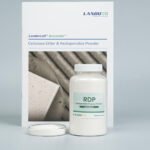
Redispersible polymer powder improves deformation tolerance inside the cement matrix and helps reduce localized stress concentration during drying and curing.
Yes. Weak concrete surfaces, uneven absorption, poor priming, or existing movement in the substrate can transfer stress directly into the leveling layer.