Many contractors still use “stucco” and EIFS interchangeably. On-site, though, they behave nothing alike.
Traditional stucco is heavy, cement-driven, and highly dependent on weather conditions and curing control. EIFS systems is lighter and more energy-efficient, but far more sensitive to system balance — especially around adhesion, flexibility, mesh reinforcement, and moisture management.
That difference becomes obvious during installation.
A traditional stucco wall may crack because the render dries too quickly. An EIFS façade may fail because the adhesive mortar, insulation board, mesh layer, and finish coat are not working together as a system.
This is why modern exterior wall systems are no longer just about cement and sand. Contractors and dry mix manufacturers now pay much closer attention to water retention, open time, polymer flexibility, and mortar consistency — especially in European insulation projects where ETICS systems continue to grow.
For companies developing façade mortars, the discussion today is less about “stronger cement” and more about long-term system stability.
Traditional stucco is still widely used in many exterior applications. The material structure itself is relatively straightforward:
Some modern formulations may include fibers or polymer modification, but the system still behaves primarily like a rigid cement render.
That rigidity is both its strength and its weakness.
Traditional stucco usually offers:
But on-site performance can become inconsistent when weather conditions change.
Most contractors who regularly apply cement renders have seen the same issues:
In summer conditions, especially on absorbent substrates, applicators often notice the mortar becoming dry and difficult to spread only a short time after mixing.
The problem is not always the cement itself.
Very often, the issue is water control inside the mortar.
This is one reason modern render formulations increasingly rely on cellulose ether to stabilize water retention and improve workability consistency during application.
On-site crews rarely describe the issue as “poor rheology”.
They usually say:
“The material doesn’t stay workable on the wall.”
That difference matters.
Because in real construction environments, labor efficiency often determines whether a formulation succeeds or fails.
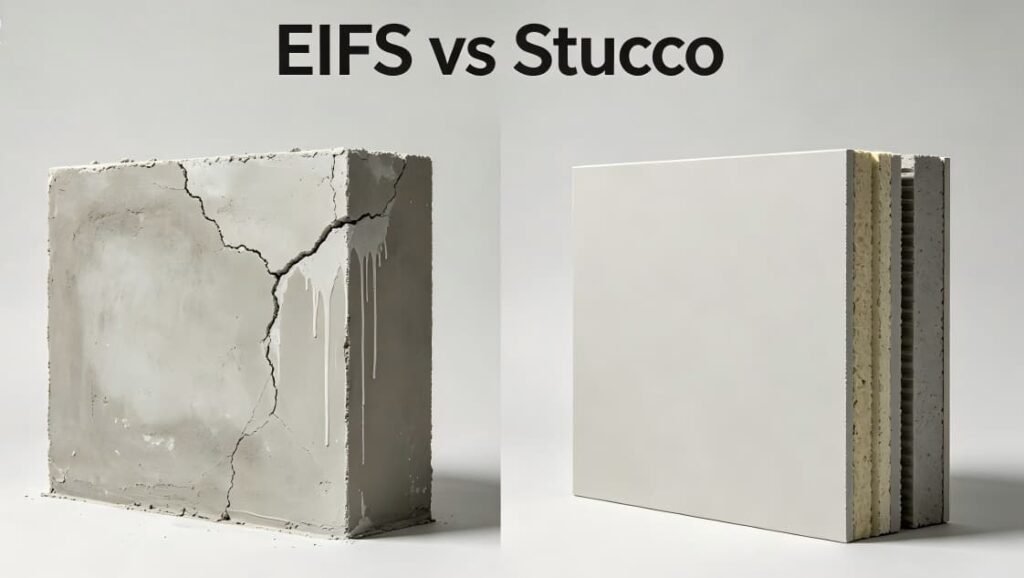
The biggest difference between EIFS and traditional stucco is not appearance.
It is structure.
A standard EIFS assembly typically includes:
Unlike traditional stucco, EIFS systems performance depends heavily on how these layers interact together over time.
The system is lighter.
But it is also more sensitive.
A façade can look perfectly finished during installation and still develop problems months later if the mortar flexibility, bonding behavior, or moisture handling are unstable.
Typical failures include:
This is why polymer-modified mortars are widely used in EIFS instead of purely cement-based mixes.
Cement alone is often too brittle for lightweight insulation assemblies.
Modern EIFS adhesive mortars therefore use redispersible polymer powder to improve:
At the same time, cellulose ether for EIFS mortars helps control:
Experienced applicators usually recognize another common site issue immediately:
Once the mortar loses workability, workers start adding extra water.
That is often where long-term performance problems begin.
Exterior wall failures rarely begin in the laboratory.
They usually begin during installation.
And EIFS and traditional stucco tend to fail in very different ways.
Traditional stucco failures are usually easier to identify because the system itself is relatively simple.
Common problems include:
On low-cost formulations, poor water retention often creates inconsistent hydration across the wall surface.
That leads to uneven appearance and localized cracking later.
Applicators may also complain that the material feels “heavy” or “sticky” during spreading.
Again, this is rarely just a cement issue.
In many cases, mortar stability and additive balance are the real cause.
EIFS failures are more complicated because the system itself is layered.
A weak point anywhere in the assembly can affect the entire façade.
The most common on-site EIFS issues include:
Many of these failures are linked to insufficient mortar flexibility or unstable adhesive performance.
For example:
The visible problem appears on the wall.
But the real problem usually started inside the mortar formulation.
This is why many manufacturers now pay closer attention to EIFS adhesive formulation balance rather than focusing only on cement strength.
In practical terms, a stable EIFS mortar needs to perform well not only in laboratory testing, but also during:
That difference is often underestimated.
EIFS and ETICS systems continue to expand across Europe for one main reason:
energy efficiency requirements.
More renovation projects now require improved thermal insulation without significantly increasing wall weight.
That makes lightweight insulation systems far more attractive than traditional thick cement façades.
Across both residential and commercial projects, contractors increasingly prioritize:
This is especially visible in:
However, lighter systems also create stricter material requirements.
As façade systems become thinner and more flexible, mortar performance becomes more critical.
Poor adhesion, insufficient flexibility, or unstable water retention can quickly lead to cracking or long-term durability issues.
This is one reason European dry mix manufacturers now focus more heavily on:
rather than simply reducing formulation cost.
Exterior mortars today are no longer treated as simple site-mixed materials.
Modern EIFS and render systems behave more like engineered assemblies.
For dry mix manufacturers, the real challenge is often not achieving high laboratory strength.
The real challenge is maintaining stable on-site behavior across different climates, substrates, and application conditions.
This is where additive selection becomes critical.
In EIFS adhesive mortars and base coats, manufacturers increasingly optimize formulations around:
LANDU cellulose ethers and redispersible polymer powders are commonly used in these applications to help stabilize mortar performance under practical construction conditions.
Particularly in:
the balance between workability and durability is often more important than chasing a single high technical number.
Many formulation adjustments made later by manufacturers are not actually about compressive strength.
They are about solving site complaints such as:
“The mortar feels inconsistent during application.”
That is usually a formulation stability issue rather than a cement issue.
From a distance, EIFS and traditional stucco can appear very similar.
Behind the façade, however, they operate according to completely different material logic.
Traditional stucco depends more heavily on thickness and cement structure.
EIFS depends far more on system coordination between insulation boards, reinforcement layers, polymer-modified mortars, and finishing materials.
As European insulation standards continue to evolve, EIFS systems and ETICS systems will likely continue expanding across renovation and energy-efficiency projects.
For dry mix manufacturers, long-term façade stability increasingly depends on factors such as:
rather than cement content alone.
And in practice, those details are often what determine whether a façade performs well five years later — or returns as a repair project.
No. Traditional stucco is primarily a cement-based plaster system, while EIFS is a multi-layer exterior insulation system that includes insulation boards, reinforced base coats, and synthetic finish layers.
EIFS cracking is commonly related to poor flexibility, weak mesh reinforcement, unstable adhesive mortar performance, or improper installation conditions.
EIFS generally offers much higher insulation performance because the system includes continuous exterior insulation boards.
Redispersible polymer powder improves flexibility, adhesion strength, crack resistance, and impact performance in EIFS adhesive and base coat formulations.
Cellulose ether helps improve water retention, workability, open time, and anti-sag performance during mortar application.
Traditional stucco alone usually cannot meet current insulation requirements without additional exterior insulation systems.