
FORMULATION TROUBLESHOOTING
Bleeding and Segregation in Self-Levelling Mortar: A Formulation Troubleshooting Guide
Identify what is separating, isolate the variables and build a controlled trial plan for a mortar that flows and remains uniform.
CEMENT-BASED DRY-MIX SYSTEMS
Where to start
First verify actual mixing water and reproduce the problem against a reference. Check changes in sand, filler and binder batches, then compare PCE and cellulose ether under controlled conditions. Record separation alongside flow and setting, and confirm promising changes at the intended thickness and mixing or pumping conditions. Reaching a target spread diameter alone does not demonstrate stability.1
Scope: cement-based self-levelling mortar. Calcium-sulfate-based systems need separate evaluation. The sequence below is a proposed workflow for internal formulation development.
Identify What Is Separating
Bleeding, settlement and segregation describe related processes:
- Bleeding involves the movement of mixing water within, or its emergence from, freshly placed cementitious material.
- Settlement, also described as sedimentation in this context, is the downward movement of solid particles before initial setting.
- Segregation is the broader loss of uniform distribution between components.
These processes can occur together. A mixture may show both surface water and a concentration of solids near the bottom.2
Use the following observations to decide what to investigate.
| Observation | What it may indicate | Useful first check |
|---|---|---|
| Water accumulates on the surface or around the spread | Bleeding | Confirm actual water accumulation and record when it appears; sheen alone is insufficient. |
| A sand-rich or visibly denser layer develops at the bottom | Settlement | Compare the top and bottom of a separate specimen using a repeatable inspection procedure. |
| Paste-rich and aggregate-rich regions appear during spreading | Segregation during flow | Check whether the pattern repeats under the same mixing and spreading conditions. |
| Foam, bubbles or pinholes dominate the surface | A possible air-related issue requiring separate investigation | Record mixing conditions and bubble behaviour alongside stability observations. |
On a narrow screen, scroll the table sideways to see all columns.
Use the circumstances of the failure to choose the next comparison. If separation appears after a water increase, repeat the water comparison with the dry formulation unchanged. If it follows a raw-material change, compare the new material with a retained reference. If it appears only during pumping or placement, include those conditions in the investigation. These patterns guide testing; appearance alone does not establish a unique cause or confirm uniformity through the full mortar depth.
Establish a Reproducible Reference
Before changing the formulation, repeat the problem under controlled conditions. Where possible, prepare the current formulation and a previously successful reference on the same day.
Record the complete dry formulation, raw-material grades and batch numbers, added water, mixing sequence, mixer and batch size, mixing time, any rest or remixing period, and material temperature. Define the test clock consistently, for example from first contact between water and dry mix.
For a placement problem, also record layer thickness, substrate preparation, primer and whether the material was mixed manually or pumped.
Make every dosage basis explicit. A useful convention for powder additives is kilograms of product as supplied per tonne of total dry mortar. If a dosage is expressed relative to binder mass, define which components are included in that binder. Record water addition against the total dry mix; if using a water-to-binder ratio, document its denominator separately.
An equal mass of two commercial additives does not necessarily mean equal active content. Describe such comparisons as being on an as-supplied basis, unless verified composition data justify another basis.

Check the Formulation in a Controlled Order
Verify actual water addition
Excess mixing water can contribute to bleeding and segregation in cement-based self-levelling mortar.3 Start by checking what entered the mixer.
Confirm the accuracy of water weighing or metering, bag or batch mass, and any later water additions. For a pump trial, compare the recorded water setting with actual delivery. Where moisture variation in raw materials is relevant, include it in the investigation.
In the laboratory, compare the reference with controlled water adjustments while keeping the dry formulation and mixing procedure unchanged. Record stability together with initial flow and flow retention.
A reduction in visible water separation accompanied by unacceptable flow is a trade-off that needs further formulation work.
Check sand, filler and binder consistency
Review changes in sand grading, filler fineness and proportion, and binder source or batch. Water content, aggregate grading and admixtures are recognised influences on bleeding in cementitious systems.4
Compare available sieve or particle-size data with those from successful production. Check storage condition, caking and dry-blend uniformity. If a problem began after a raw-material change, a controlled comparison with the previous material can be more informative than immediately changing several additives.
Treat grading adjustments as formulation trials. Adding more fines is not a universal correction: changes in particle distribution can also change the water and dispersant needed to reach the intended flow.
Keep the dry batch total constant and identify which balancing component is adjusted whenever a formulation component changes.
Reassess PCE at fixed water
A polycarboxylate superplasticizer, or PCE, helps disperse cementitious particles. Its effect on flow should be evaluated together with stability; research on cement and limestone pastes has examined these responses as separate outcomes.1
First compare selected PCE levels at fixed water, using the same binder, cellulose ether and other ingredients. Look for a useful operating range in which flow, retention and stability meet the development targets.
If evaluating a different PCE grade, document its identity and dosage basis. Avoid changing water, PCE grade and cellulose ether simultaneously during the first comparison.
A PCE adjustment that improves the spread diameter still needs a stability check. Likewise, visible separation in one trial does not establish that the PCE grade is unsuitable across all binder systems.

Evaluate cellulose ether in the complete mortar
Application-specific cellulose ethers can help maintain suspension while allowing self-levelling flow. Supplier guidance describes low-viscosity grades selected for this balance.5
Select candidate grades for the application and compare them in the complete formulation. Judge their effect through flow, stability, working time and surface quality. A solution-viscosity specification alone is insufficient for this decision.
Compatibility also matters. Published experiments on PCE-plasticised cement paste found that adding HPMC changed yield stress and plastic viscosity in the systems tested. Those results support checking the combination in the actual formulation; they do not establish a universal incompatibility between HPMC and PCE.6
For the separate question of viscosity selection, see HPMC Viscosity in Self-Leveling Mortar: Flow Retention & Surface Finish.
Review setting control and the timing of separation
Record whether separation appears immediately, during the intended working period or only after an unusually long delay in setting.
A study of a Portland cement–calcium aluminate cement–anhydrite self-levelling system found that changes to cellulose ether, PCE and tartaric acid affected fresh or hardened performance. Its results underline the importance of evaluating the full additive package, including setting control.3
If the issue follows a change in binder, retarder or accelerator, reproduce that change in a controlled comparison. Record temperature and setting behaviour alongside flow and stability.
Any adjustment must preserve the required working period and subsequent strength development. An earlier loss of mobility alone is insufficient evidence that the formulation has improved.
Separate Fixed-Water Screening from Target-Flow Comparison
These two trial stages answer different questions.
Fixed-water screening asks what happens when a selected formulation variable changes under the same water condition. Keep the remaining ingredients, preparation procedure, temperature and test timing controlled.
Target-flow comparison asks how each candidate performs when adjusted to reach the intended application flow. State exactly which variable is used for that adjustment.
For example, if water is changed to bring two cellulose-ether variants to the same initial spread, the outcome describes each adjusted formulation. It cannot be attributed entirely to the cellulose ether. The same spread diameter also does not establish identical flow retention or rheological behaviour.
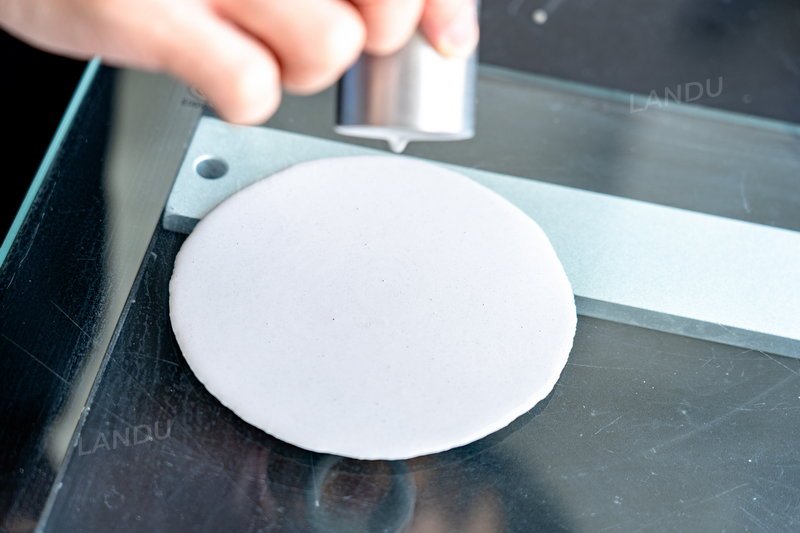
A practical first-stage plan is:
| Trial | Deliberate change | Main question |
|---|---|---|
| Reference repeat | None | Can the original flow and separation behaviour be reproduced? |
| Water series | Added water only | How sensitive is the current formulation to water variation? |
| PCE series | PCE dosage at fixed water | Where is the useful balance between dispersion, flow and stability? |
| Cellulose-ether series | Grade or dosage at fixed water | Which candidate improves the required combination of properties? |
| Raw-material comparison | One defined sand, filler or binder change | Does a material change explain the difference from successful production? |
On a narrow screen, scroll the table sideways to see all columns.
These are screening trials. Follow promising results with targeted combinations to examine interactions; one-variable comparisons alone do not establish the final optimum.
Make Stability Observations Repeatable
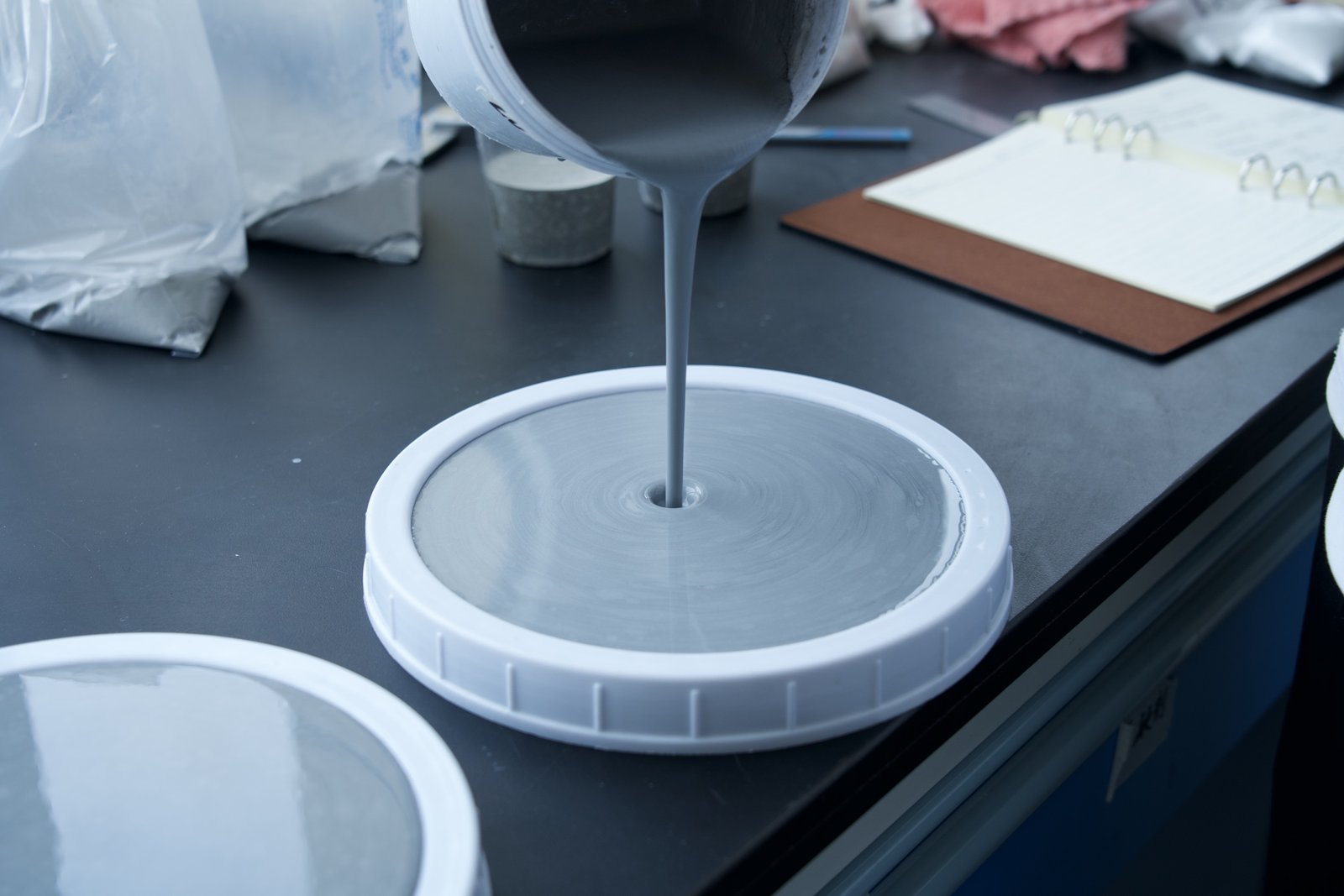
A transparent container can be useful for internal comparative screening. It allows observation of surface water, visible layer formation and changes with time. It does not reproduce every condition encountered in a thin floor layer.
Write an internal procedure before comparing candidates. Keep container shape, fill depth, sampling point, filling method and observation times consistent. Control temperature and exposure to evaporation.
Use separate specimens for undisturbed stability observations and for tests involving remixing, pouring or repeated flow measurements. Disturbing a specimen changes the conditions being observed.
For each stability specimen, record:
- Time of first visible separation and how it develops.
- Surface water accumulation, with measurement where the internal method permits.
- Visible differences between the top and bottom.
- Photographs taken with consistent lighting, background and scale.
Where internal separation is suspected, examine separate specimens using an appropriate top-to-bottom comparison or a hardened cross-section. Document the method and its limits. Colour differences alone do not quantify solids distribution.
Record fresh density and, where relevant, air content using suitable methods. Fresh density is not itself an air-content percentage. If bubbles or pinholes are a separate concern, include a controlled evaluation of mixing and the air-control package; do not assume that a defoamer adjustment will correct solids settlement.
Define trial acceptance against the product’s intended use and established quality requirements. A convenient container test does not create a universal bleeding limit.
Confirm Performance at the Intended Layer Thickness
A promising laboratory result needs verification under representative application conditions.
Prepare trial areas at the intended thickness, with a defined substrate and primer system. Use the relevant mixing procedure and, for pump-applied products, include a representative pumping trial. Record the water actually used.
Check whether the mortar remains uniform during placement, levels as required and produces an acceptable surface. Investigate any difference between the laboratory and placement trial before accepting the formulation.
Include the product’s required hardened-property checks, such as strength, bond performance and dimensional behaviour where applicable. A visually stable fresh mix still needs to meet those requirements.
EN 12706 provides a European test-method reference for flow characteristics of hydraulic-setting floor smoothing and levelling compounds.7 Keep the internal stability screen separate from applicable standard tests and finished-product requirements.
The distinction between comparison and field performance is also explicit in ASTM C1708/C1708M: its self-levelling mortar tests are conducted under standardised conditions, and their results are not intended to represent field performance.8
Select the Formulation That Meets the Whole Requirement
Set the initial-flow target, flow-retention requirement and internal stability acceptance criteria before the trial series. Use consistent observation times spanning the intended working period and the relevant interval before setting. Review candidates against the following requirements:
- Required initial flow and flow retention.
- Acceptable resistance to bleeding and particle separation.
- Appropriate levelling, surface finish and working period.
- Required setting and hardened properties.
- Repeatability across relevant raw-material batches and application conditions.
Repeat promising results in independently prepared batches, with a reference tested alongside them. Advance a candidate when the improvement is reproducible and the other required fresh and hardened properties remain acceptable. A candidate that works only at one tightly controlled water level may need further development before production approval.
Retain a reference formulation and a clear change record. This makes future investigations more useful: the team can identify what changed and compare it against documented results.
PLAN YOUR NEXT FORMULATION TRIAL
Discuss your self-levelling formulation with LANDU
Start with your binder system, the separation you observe and when it appears. Ask about suitable product information and sample availability for your own comparison.
Useful information to share
- Binder system and visible separation
- When it occurs: mixing, standing or placement
- If available: water basis, additive grades, flow results, layer thickness and photographs
What to request
- Current technical and safety data sheets
- Trial-dose basis and test conditions behind quoted data
- Typical values, supplied specifications and available batch documentation
For a commercial comparison, include the delivery destination and ask about packaging, lead time and a quotation. Evaluate price together with validated dosage and finished-mortar performance. Share further formulation details within your company’s disclosure limits.
Request product data & sample optionsTechnical references
- Mikanovic & Jolicoeur (2008). Influence of superplasticizers on the rheology and stability of limestone and cement pastes.
- ACI Concrete Terminology, ACI CT-25. Bleeding, settlement and segregation.
- Wang et al. (2023). Effect of Chemical Admixtures on the Working Performance and Mechanical Properties of Cement-Based Self-Leveling Mortar.
- Caltrans. Concrete Technology Manual, Chapter 1: Structure Concrete Characteristics.
- SE Tylose. Cement Based Renders and Trowelling Compounds: Self-levelling compounds.
- Ma et al. (2018). Effect of HPMC on rheology of cement paste plasticized by polycarboxylate superplasticizer.
- DIN EN 12706:1999-12. Official catalogue: determination of flow characteristics.
- ASTM C1708/C1708M-26. Official public scope and significance statements.
Research findings apply to the systems tested. Supplier application guidance does not establish a universal dosage or verify a LANDU grade. The internal screening workflow in this article is separate from standard test procedures.