01 — The core problemWhy viscosity alone doesn't determine HEC selection
Q: Why does viscosity alone not determine HEC selection?Viscosity grade tells you how much a given loading will thicken the system at rest. It does not tell you how the paint behaves under the shear of brushing, rolling, or spraying, how it holds up on a vertical surface, or how long it holds that viscosity in storage. Two products with an identical viscosity number can behave very differently once shear, pH, electrolyte content, or time enter the picture — because viscosity is a single-point measurement, and paint performance is shear-dependent and time-dependent.
This is also why comparing a 1% solution reading against a 2% solution reading — a common mismatch between supplier data sheets — produces a false equivalence before formulation even begins.
Selection should start with the thickening mechanism the application requires, then narrow to a viscosity grade within that mechanism category — not the reverse.
02 — FrameworkStart with mechanism, not viscosity number
LanderColl® HEC is organized into four product categories, and each one solves a different formulation problem. Picking the category first, then narrowing to a grade within it, is the more reliable path than starting from a target viscosity and working backward.
Straightforward thickening at the best cost efficiency. The right starting point when your formulation has no specific rheology-control requirement beyond building viscosity — e.g. a standard interior emulsion where sag resistance and spatter control aren't critical failure points. Grades run from HE15M through HE200M, covering a 1% solution viscosity range of roughly 800–8,000 mPa·s.
Exists for one reason: viscosity retention over time. HE-BE grades carry a higher molar substitution (MS) and more uniform substitution than standard HE grades — biostability increases as MS increases. Specify this category when your paint has a long shelf-life requirement, a lean biocide package, or will sit in warm, humid storage before sale.
HE-BE also includes low-viscosity grades (HEC LR, ER, GR) that function as dispersants for emulsion polymerization and colorant/paste systems — not thickeners. Worth noting if your spec conflates "HEC" with "thickener" only.
Carries a hydrophobic modification that improves dispersibility, suspension stability and, notably, scrub resistance. If your target product is a scrub-resistant interior/exterior emulsion, or pigment/filler suspension stability is a recurring QC issue, MEB is built for that — not standard HE. Grades span MEB15M (800–1,500 mPa·s) up to MEB10000 (9,000–12,000 mPa·s), so cost-efficiency and high-build thickening sit within the same category.
The category to specify when application performance — not just can viscosity — is the priority: leveling, anti-spattering during roller application, anti-sag on vertical surfaces. Associative HEC thickens through conventional hydrogen bonding and molecular entanglement and through hydrophobic association with latex particles, giving a dual thickening effect. That second mechanism is what gives associative grades their edge in construction-site performance. MHE is also the recommended category for water-based paste putty, not just paint.
03 — Quick lookupMatching category to application: a working reference
| Formulation priority | Recommended category | Why |
|---|---|---|
| Baseline thickening, cost-sensitive standard paint | HE | Best cost efficiency for straightforward viscosity build |
| Dispersant for emulsion polymerization or colorant paste | HE-BE (LR/ER/GR) | Purpose-built dispersant function, not primarily a thickener |
| Long shelf-life, lean biocide package, humid/warm storage | HE-BE (mid/high) | Higher MS correlates with better biostability and viscosity retention |
| Scrub-resistant paint, pigment/filler suspension stability | MEB | Hydrophobic modification improves dispersion and scrub resistance |
| Roller application with spatter concerns, vertical sag, water-based paste putty | MHE | Dual thickening mechanism (hydrogen bonding + latex association) |
04 — Grade referenceViscosity grade reference
Once the category is set, narrow to a grade using the concentration-matched viscosity range below. Always confirm the test concentration (1% or 2%) against your own formulation's loading before finalizing a grade — don't select purely off the mPa·s number.
| Category | Grades | Test conc. | Viscosity (mPa·s) |
|---|---|---|---|
| Normal & Standard (HE) | HE15M – HE200M | 1% | 800 – 8,000 |
| Biostable — dispersant grades | HEC LR / ER / GR | 2% | 7 – 400 |
| Biostable — thickening grades | HE2MBE, HE5MBE | 2% | 1,500 – 6,500 |
| Biostable — thickening grades | HE15MBE – HE100MBE | 1% | ~800 – 5,000 |
| Hydrophobically Modified (MEB) | MEB4M | 2% | 3,000 – 5,000 |
| Hydrophobically Modified (MEB) | MEB15M – MEB10000 | 1% | ~800 – 12,000 |
| Associative (MHE) | MHE300 – MHE2000 | 1% | 200 – 2,500 |
| Associative (MHE) | MHE4PX, MHE10PX, MHE20PX | 2% | 4,000 – 21,000 |
| Associative (MHE) | MHE30PX – MHE100PX | 1% | up to ~5,000 |
For exact figures against your target grade, request the full grade table or TDS — the ranges above are for category-level comparison, not final formulation dosing.
05 — By productHow to select HEC according to paint application
Category selection gets more concrete once tied to a specific end product. The five scenarios below cover the applications formulators most commonly source HEC for — each has a different primary failure mode, which is what should drive grade selection, not the product name.
Interior latex paint HE → MHE
- Challenge
- Enough viscosity for hide and roller pickup without dragging or over-thickening at low shear, at the lowest defensible cost.
- Consideration
- Interior paints are usually judged on ease of application and finish uniformity, so standard-substitution HE's cost efficiency is normally justified — unless the brief calls for a low-spatter, professional-grade feel, where MHE's dual mechanism becomes the differentiator.
Exterior wall coating HE-BE → MEB
- Challenge
- Maintaining viscosity and suspension stability through prolonged storage, UV/heat exposure at point of sale, and climate-driven humidity.
- Consideration
- Exterior products spend longer in the supply chain before use, so biostability is a more decisive factor here than raw thickening efficiency.
Scrub-resistant paint MEB
- Challenge
- Washability and scrub performance without compromising film formation or filler suspension stability.
- Consideration
- The one application where the category choice is close to non-negotiable — a standard HE grade at similar viscosity will not replicate MEB's scrub performance.
Decorative coating MHE
- Challenge
- Leveling, sag resistance on vertical or textured surfaces, and visible appearance consistency — decorative finishes are judged by eye.
- Consideration
- Associative mechanism's leveling and anti-sag behavior is built for exactly this failure mode, more than for raw thickening.
Water-based coating systems Any, by end-use
- Challenge
- Compatibility across a broad pH and electrolyte range, since loads vary batch to batch.
- Consideration
- HEC's nonionic character — stable pH ~3.5–11, tolerant of a wide electrolyte range — is the reason HEC is chosen over ionic thickener classes in the first place, independent of category.
06 — Process behaviorRheology and process-tolerance factors
Beyond thickening level, three characteristics of HEC as a chemistry class affect how forgiving a formulation is in production.
pH and electrolyte tolerance
HEC is nonionic and holds stable viscosity across roughly pH 3.5–11, with good tolerance to a wide range of electrolytes — useful if your pigment/filler system introduces variable salt loading batch to batch.
Thermal stability
LanderColl® HEC has no gelation point and stays a stable, transparent colloidal solution above 120°C — relevant for manufacturing processes involving heat and for storage/transport through high-ambient-temperature markets.
Dissolution behavior
As a surface-crosslinked powder, HEC has intentionally delayed solubility — it disperses into fine particles before hydrating into a transparent solution, which prevents lumping during manufacture. Hydration time decreases as water temperature increases, and dissolution can be accelerated by adjusting pH to 7.0–8.5 with a mild alkaline additive such as AMP-95. Incomplete dissolution is usually a process-parameter issue — cold water, low pH, insufficient shear — worth ruling out before escalating a quality complaint.
07 — Buyer errorsCommon mistakes buyers make when purchasing HEC
- Selecting on price and viscosity number alone, without checking the test concentration behind the figure — the single most common cause of a grade "not performing as expected."
- Treating all HEC as interchangeable across categories because they share a viscosity range. A MEB grade and an HE grade can carry the same mPa·s number and still behave differently under shear or in scrub testing.
- Skipping a small-batch trial before a full production run, particularly when switching suppliers.
- Not asking what biocide package or storage assumptions the viscosity data was generated under — "stable viscosity" without a time and condition reference isn't verifiable.
08 — Risk pointsWhat to verify when switching HEC suppliers
Supplier switches are where sourcing risk concentrates — a new source can match every published spec and still perform differently in production.
- Viscosity at your actual use concentration — recheck at the loading level your formulation actually runs, not the one on the new data sheet.
- Substitution level (MS) range — a "biostable" label should be checked against a stated MS range, not taken at face value.
- Particle size and dissolution behavior — affects mixing time and lump risk on your specific equipment.
- Batch-to-batch consistency, ideally across more than one lot — a single COA confirms one batch, not the supplier's process control over time.
Why batch-to-batch consistency matters more than a single COA
A Certificate of Analysis tells you one specific batch met spec at the time of testing — not whether the next batch lands in the same place. For a rheology modifier, even in-spec variation between batches can shift viscosity build enough to require rework downstream. Requesting COAs across multiple lots is a more meaningful data point than a single passing COA, particularly ahead of a bulk order.
Lab-scale testing vs. production-scale validation
A grade that performs correctly in a lab-scale drawdown doesn't automatically perform identically at production scale: mixing shear profiles differ between lab and plant-scale dispersers, hydration behaves differently in a larger batch, and storage/transport conditions rarely match. Lab evaluation narrows a shortlist — it isn't a substitute for a scaled-up trial before a grade is locked in, particularly for associative (MHE) grades where shear-dependent behavior is the entire point.
09 — Due diligenceHEC supplier evaluation checklist before bulk purchase
Comparing suppliers on price and viscosity number alone is not sufficient due diligence for a rheology-critical raw material.

- TDS accuracy — does the sheet state the viscosity test method and equipment (e.g. Brookfield, spindle/speed) and concentration, or just a bare number?
- Viscosity test method and concentration — 1% or 2%, and does that match how you'll benchmark internally?
- COA consistency between batches — request COAs from more than one production lot.
- Sample testing in your own formulation — run through your actual mixing and application process, not a drawdown against the supplier's reference formulation.
- Storage stability data — viscosity retention over a stated time and condition, particularly for HE-BE grades.
- Technical support capability — can the supplier support grade selection and troubleshooting, or only fulfill catalog orders?
10 — ManufacturerAbout LANDU as a cellulose ether manufacturer
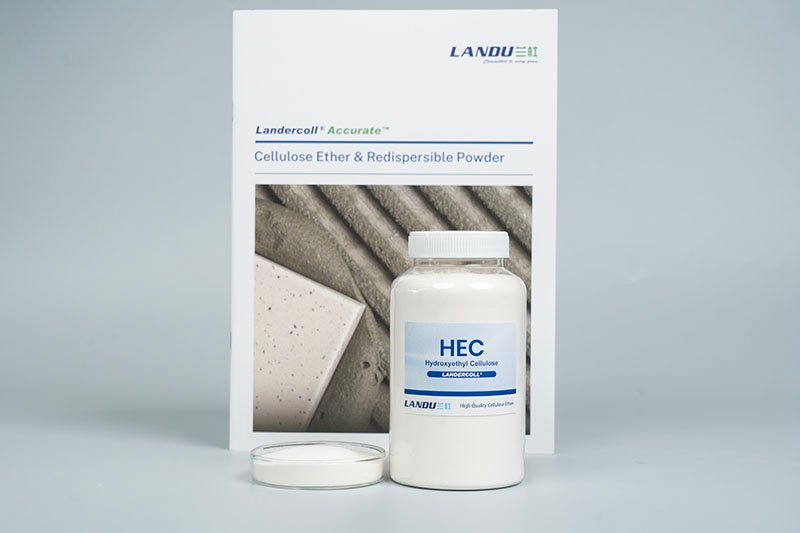
LANDU · LanderColl® HEC
LANDU produces HPMC, MHEC/HEMC, and HEC — marketed under the LanderColl® line — alongside redispersible polymer powder and other construction chemical additives. The HEC range follows the category structure in this guide: Normal & Standard, Biostable, Hydrophobically Modified, and Associative, with grade-level TDS and COA available by grade to support formulation and specification work.
For buyers evaluating a switch or a new formulation, LANDU's technical service supports grade selection based on target application, sample evaluation ahead of bulk order, and formulation-stage troubleshooting.
11 — FAQFrequently asked questions
How do I know which HEC viscosity grade to specify for my paint formulation?
Start with the application requirement — standard thickening, scrub resistance, leveling/anti-sag, or dispersant function — to select the category, then choose a viscosity grade within it based on your target final-product viscosity, confirming the test concentration matches how you'll evaluate the finished paint.
Which HEC viscosity grade is suitable for a scrub-resistant exterior paint?
Category first: MEB is built for scrub resistance and suspension stability. Within MEB, mid-range grades (e.g. MEB60M–MEB100M) are a reasonable trial starting point, confirmed against your own concentration and application method rather than assumed from the category alone.
Why does my HEC-thickened paint lose viscosity in storage?
Usually a biostability issue tied to degree of substitution and biocide package, not a single-batch defect. For long shelf life or humid/warm storage, a higher-MS biostable grade (HE-BE) is the category built to address it — check grade-specific storage data with your supplier rather than assuming any standard HEC holds viscosity equally well.
Can HEC be used across all water-based latex paint systems?
As a nonionic thickener, HEC has broad compatibility across latex chemistries and tolerates a wide pH and electrolyte range — one reason it's chosen over ionic thickeners where pigment/filler electrolyte content is variable. Still confirm with a formulation trial, since latex particle interactions — particularly with associative grades — are formulation-dependent.
Why does my HEC form lumps when I add it to water?
Surface-crosslinked HEC powders are designed with delayed solubility to prevent lumping, but incomplete dispersion before hydration — cold water, low shear, low pH — can still cause clumping. Raising water temperature, increasing dispersion shear, or adjusting pH toward 7.0–8.5 typically resolves it; usually a process condition, not a product defect.
Does a higher viscosity grade always mean better thickening performance?
No. Viscosity grade tells you how much a given loading thickens the system — not how the paint behaves under the shear of brushing, rolling, or spraying. That's a function of thickening mechanism (conventional vs. associative), which is why category selection comes before grade selection.
How should buyers compare HEC suppliers before placing a bulk order?
Not on price and viscosity number alone. A meaningful comparison covers test method and concentration disclosed on the TDS, COA consistency across multiple batches, sample performance in the buyer's own process, storage stability data where shelf life matters, and whether technical support can assist with selection and troubleshooting rather than only order fulfillment.
What should be re-verified when switching HEC suppliers mid-production?
Viscosity at the buyer's actual use concentration, substitution level (MS) if biostability matters, particle size and dissolution behavior on the buyer's own equipment, and batch-to-batch consistency across more than one lot — a single passing sample doesn't confirm consistent performance at volume.