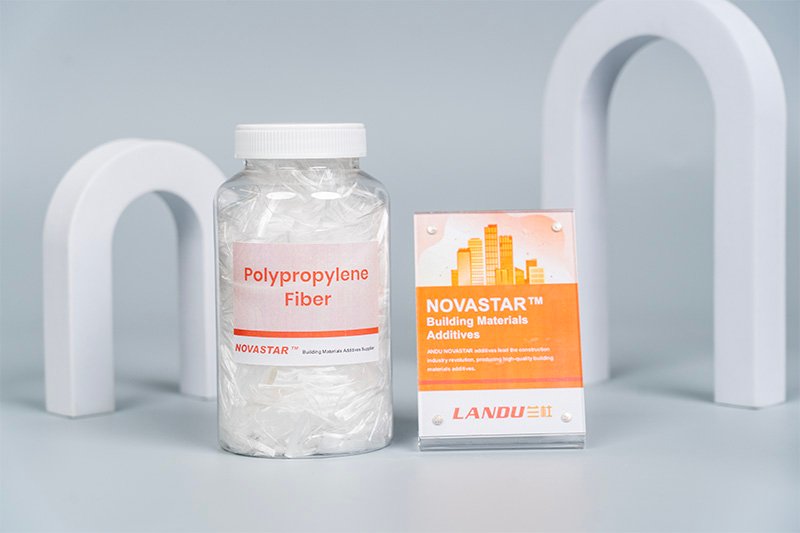
Buy Polypropylene Fiber
7 Things to Know Before Buying Polypropylene Fiber
LANDU Technical Guide | Concrete Reinforcement Fiber Series
Introduction: Polypropylene Fiber Solves Early Concrete Cracking Headaches
For concrete manufacturers, cracking problems are rarely caused by one single factor.
A concrete product can leave the production line with acceptable strength, but cracks may appear during curing, demolding, transportation, or final installation. For precast manufacturers, these small defects often lead to product rejection, rework, and customer complaints.
This is why polypropylene fiber is widely used in concrete products as a practical solution for controlling plastic shrinkage cracks and improving crack resistance.
LANDU supplies polypropylene fiber solutions for concrete manufacturers, including high-strength monofilament fiber and mesh fiber produced from polypropylene raw materials with controlled diameter and mechanical performance.
1. Root Causes of Early-Age Cracking in Concrete
During the early curing stage, concrete suffers volume deformation triggered by four key factors:
- Rapid moisture evaporation
- Cement hydration heat release
- Ambient temperature fluctuation
- Continuous drying shrinkage
Before concrete gains enough compressive and tensile strength, internal shrinkage stress generates microcracks on surfaces or inside matrix. This issue severely troubles producers of:
- Precast concrete components
- Concrete blocks
- Cement fiber boards
- General precast concrete products
Early cracks directly damage surface appearance, lower production pass rate, and reduce customer recognition. Traditional steel rebars only bear structural loads, yet most factory defects stem from early shrinkage cracking — exactly the problem polypropylene fiber is engineered to fix.
2. Working Mechanism of PP Fiber Inside Concrete
Polypropylene fiber is evenly blended and dispersed into concrete during mixing procedures. After full separation, countless single fibers interlace to form a 3D microscopic reinforcing network throughout the cement matrix, inhibiting microcrack initiation and expansion.
Core functional values of PP fiber:
- Effectively restrain plastic shrinkage cracking
- Block crack propagation paths
- Boost overall toughness of cementitious composites
Critical reminder: Polypropylene fiber cannot replace structural steel reinforcement. Its core advantage lies in early-age crack control and long-term durability improvement for cast and precast concrete.
3. Key Factors Deciding PP Fiber Quality Gap
Visually similar polypropylene fibers show huge performance gaps, determined by five core production links:
- Virgin polypropylene raw material grade & purity
- Filament diameter precision control
- High-temperature stretching forming process
- Final tensile strength index
- Anti-clustering surface dispersion treatment
Manufacturers should avoid purchasing based solely on unit ton price. Low-performance fiber demands higher addition dosage to reach equal anti-crack effect, pushing up total raw material expenditure.
High-Strength Monofilament vs Low-Cost Hollow PP Fiber
Many cheap hollow fibers adopt recycled inferior PP feedstock with obvious drawbacks:
- Oversized single fiber diameter
- Tensile strength below 300 MPa
- High residual moisture content
- Low reinforcing efficiency per unit weight
Less effective fiber quantity distributes in concrete, weakening crack resistance significantly.
By contrast, LANDU high-strength polypropylene monofilament fiber features stable technical indicators:
- 100% pure virgin PP granules as raw material
- Tightly controlled uniform filament diameter
- Tensile strength ≥ 500 MPa
- Elastic modulus ≥ 4000 MPa
Higher strength-to-weight ratio allows lower optimal dosage while maintaining outstanding anti-crack performance.
4. How to Confirm Optimal Polypropylene Fiber Dosage
No universal fixed dosage fits all concrete products. The addition amount relies on multiple formulation variables:
- Complete concrete mix design ratio
- Cement content grade & proportion
- Coarse/fine aggregate particle size
- Finished product thickness specification
- Target anti-crack and durability standard
The general industry dosage benchmark for conventional concrete products ranges from 0.6–1.2 kg/m³.
Blindly raising fiber mixing dosage brings negative side effects:
- Reduced concrete mixing uniformity & efficiency
- Deteriorated slurry workability and pumpability
- Unnecessary raw material cost waste
Experienced manufacturers carry out laboratory trial mixes to lock the minimal effective dosage matching product standards. The core target is selecting high-efficiency fiber rather than adding more fiber blindly.
5. Polypropylene Fiber vs Steel Fiber: Clear Functional Differences
Many concrete producers confuse PP fiber and steel fiber, while they serve completely differentiated engineering demands.
| Comparison Item | Polypropylene Fiber | Steel Fiber |
|---|---|---|
| Core Function | Early plastic shrinkage crack control & toughness upgrade | Structural tensile & bending reinforcement |
| Base Material | Polypropylene polymer | Carbon steel |
| Corrosion Resistance | Perfect, zero rust risk | Easy rust under humid conditions |
| Weight Characteristic | Ultra-lightweight | High specific gravity, heavy weight |
| Mixing Operation | Easy dispersion, no agglomeration risk | High mixing requirement, easy balling |
| Typical Usage | Precast parts, cement boards, surface crack prevention | Road slab, tunnel lining, heavy load structural concrete |
For factories mainly troubled by surface shrinkage microcracks, polypropylene fiber delivers higher cost performance. Projects bearing heavy structural loads require steel fiber or traditional steel reinforcement systems instead.
6. Cost Optimization Logic: Focus On Total Cost Instead of Ton Quotation
Most buyers only compare suppliers’ price per ton, ignoring comprehensive production expenditure. The real overall cost formula includes three parts:
Fiber unit price + required mixing dosage + additional loss from unstable production quality
Low-priced inferior fiber increases comprehensive cost for three reasons:
- Higher addition dosage to meet crack resistance standard
- Extra mixing time and additive adjustment labor cost
- Higher reject rate caused by unqualified crack control effect
High-strength efficient PP fiber cuts overall material consumption with superior reinforcing performance. Procurement managers should shift the core question from “Which fiber is cheaper per ton?” to “Which fiber achieves standard crack control at the lowest total cost per cubic meter concrete?”
7. Seven Critical Indicators to Verify Before Purchasing PP Fiber
Manufacturers must audit the following key capabilities when screening polypropylene fiber suppliers:
1. Raw Material Quality
- ☐ Adopt virgin polypropylene granules or recycled feedstock?
- ☐ Stable batch consistency of raw material supply chain?
Raw material purity directly determines fiber tensile strength and batch performance stability.
2. Complete Mechanical Performance Index
Check full technical datasheet parameters:
- Tensile strength
- Filament diameter tolerance
- Elastic modulus
- Finished fiber moisture content
These figures decide actual anti-crack efficiency in real concrete formulas.
3. Dispersion Performance Test
Poor dispersion leads to fiber balling and uneven reinforcement inside concrete. Qualified PP fiber should have:
- Excellent single fiber separation performance
- Uniform distribution after standard mixing time
- Stable mixing effect under different mixing equipment
LANDU Polypropylene Fiber Stable Production Advantages
LANDU manufactures specialized polypropylene fiber for construction material factories demanding consistent quality and repeatable field performance. Our production strictly controls all core links affecting fiber quality:
Stable Virgin Raw Material Control
We adopt standardized virgin PP granules as raw material, implementing full-process purity monitoring to avoid performance fluctuation from recycled impure feedstock.
Precise Filament Diameter Control
Real-time physical inspection during production locks diameter tolerance. Available monofilament specifications:
- 19–22 μm
- 30–35 μm
Special Anti-Static Dispersion Surface Treatment
Custom surface coating technology eliminates static fiber adhesion, effectively reduce fiber clustering and improve homogenization during concrete mixing.
Wide Application Range of LANDU Polypropylene Fiber
Precast Concrete Products
- Concrete wall panels
- Hollow concrete blocks
- Cement drainage pipes
- All types of precast structural components
Cement-Based Building Boards
- Fiber cement boards
- Lightweight partition panels
- Cement repair mortar & anti-crack screed
General Industrial Concrete
All cast-in-place and precast concrete products requiring enhanced crack resistance and long-term durability.
Final Buying Guidance for Concrete Manufacturers
- Do not judge fiber quality merely by ton quotation; calculate total cost per cubic meter concrete comprehensively.
- Prioritize virgin raw material, high tensile strength, precise diameter and good dispersion performance when selecting fiber grades.
- Distinguish application positioning of PP fiber and steel fiber to avoid wrong material selection.
- Complete lab trial mixes to confirm optimal fiber dosage matching your local aggregate and cement system.
- Cooperate with manufacturers providing complete technical formulation support rather than only raw material supply.
Polypropylene fiber is not a simple extra material cost for concrete factories. Matching high-performance fiber efficiently solves early cracking defects, stabilizes mass production quality, and lowers overall quality control risks. When auditing PP fiber suppliers, evaluate raw material stability, mechanical indicators, diameter precision, dispersion ability and full-cycle comprehensive cost instead of single price index. Supported by standardized production lines and targeted construction application technical service, LANDU delivers reliable polypropylene fiber solutions for stable concrete manufacturing.
Get Professional PP Fiber Technical Support From LANDU
If you are troubled by frequent concrete surface cracking or looking for stable polypropylene fiber suppliers, LANDU provides exclusive technical services for concrete precast manufacturers:
- Free PP fiber grade matching for your concrete mix design
- Laboratory trial mixing test to lock optimal fiber dosage
- Comparison test between high-strength monofilament and ordinary hollow fiber
- Anti-crack formulation optimization for precast blocks, panels and pipes
- Custom fiber samples matched to your production raw materials
👉 Request polypropylene fiber samples or one-on-one concrete anti-crack formulation technical consultation via the LANDU technical team