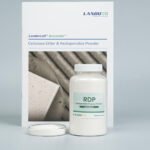
Redispersible Polymer Powder (RDP) plays a critical role in the performance of modern dry mix mortar systems. In applications such as tile adhesive, EIFS, skim coat and self-leveling compounds, the quality of the polymer powder directly affects adhesion, flexibility, workability and durability.
However, not all RDP powders perform the same way in mortar formulations.
Differences in redispersibility, film formation, storage stability and compatibility often originate from the manufacturing process itself. From polymer emulsion preparation to spray drying and surface treatment, every production stage influences the final behavior of the powder in cement-based systems.
This article explains how redispersible polymer powder is manufactured, what materials are used during production, and why process control matters for dry mix mortar performance.
Redispersible Polymer Powder is produced by converting a polymer emulsion into a free-flowing powder through spray drying technology. The powder can later redisperse in water and reform a stable polymer film inside mortar systems.
A typical RDP formulation contains several key components.
The polymer emulsion is the core functional material of RDP. The most widely used system in construction dry mix mortar applications is vinyl acetate-ethylene copolymer (VAE).
Depending on the target application, manufacturers may also use:
The polymer composition determines important mortar properties such as:
For tile adhesive and EIFS applications, VAE-based systems are commonly selected because they provide a balanced combination of flexibility and cement compatibility.
Protective colloids are essential for ensuring the redispersibility of the final powder.
Polyvinyl alcohol (PVA) is the most commonly used protective colloid in RDP manufacturing. During spray drying, it forms a stabilizing layer around polymer particles and prevents irreversible agglomeration.
The dosage and type of protective colloid significantly influence:
Poorly controlled protective colloid systems often result in powders with weak dispersion properties and unstable mortar performance.
Additional additives are introduced to optimize processing behavior and storage stability.
Typical additives include:
Plasticizers help reduce the minimum film-forming temperature of the polymer, improving low-temperature film formation.
Anti-caking agents such as calcium carbonate, kaolin and silica prevent particle adhesion during storage and transportation. These materials also contribute to the ash content of the finished powder.
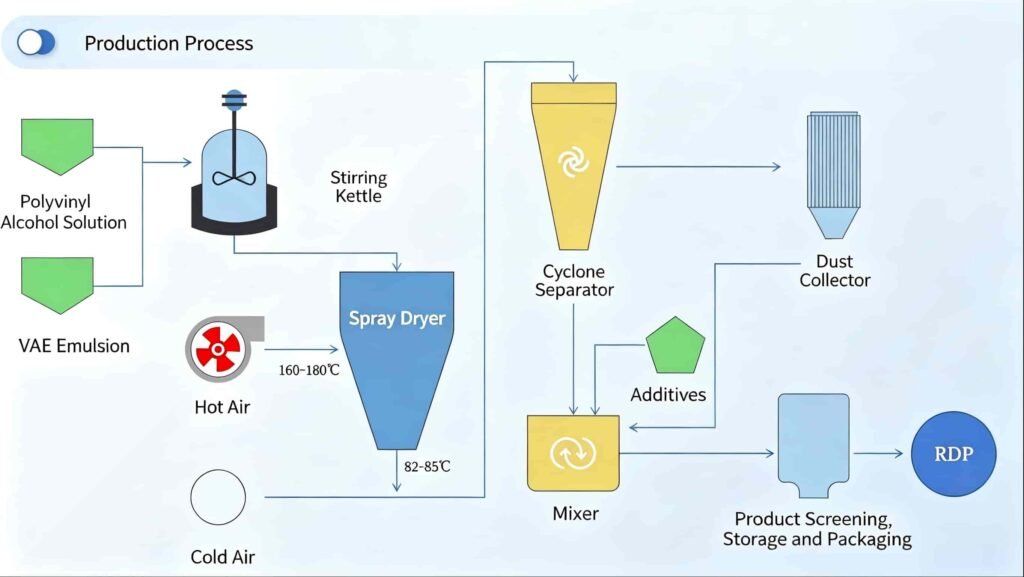
The manufacturing process of redispersible polymer powder involves several tightly controlled stages. Consistency during production is critical because even small variations in particle formation can affect mortar performance.
The process begins with the preparation of a stable polymer dispersion.
Polymer emulsion, protective colloid solution and functional additives are accurately dosed according to the target formulation. The materials are then mixed under controlled agitation conditions to create a homogeneous spray solution.
At this stage, manufacturers focus on:
A stable feed solution helps ensure consistent atomization during spray drying and reduces the risk of powder agglomeration.
Spray drying is the core process that transforms liquid polymer emulsion into free-flowing redispersible polymer powder.
The prepared dispersion is fed into a spray drying tower and atomized into micron-sized droplets using either:
Inside the drying chamber, the droplets come into contact with hot air, typically at inlet temperatures ranging from 120°C to 200°C. Moisture evaporates almost instantly, leaving behind dry polymer particles.
The spray drying stage directly affects:
| Process Factor | Influence on Final Performance |
|---|---|
| Droplet size | Particle size distribution |
| Drying temperature | Film-forming behavior |
| Moisture removal | Storage stability |
| Atomization efficiency | Powder flowability |
| Particle morphology | Redispersibility |
Well-controlled spray drying helps produce powders with stable particle size, good flowability and reliable redispersion in cement systems.
Inconsistent drying conditions, on the other hand, may cause:
For dry mix mortar manufacturers, spray drying quality often determines the consistency of the final formulation.
During or after spray drying, anti-caking agents are applied to the surface of polymer particles to improve powder handling and storage stability.
Common anti-caking materials include:
These materials create a physical separation layer between particles and help maintain free-flowing behavior during transportation and storage.
The powder is then cooled through fluidized bed systems or similar cooling equipment to stabilize the material before screening and packaging.
After cooling, the powder passes through vibration screening equipment to remove oversized particles and impurities.
The finished product is then automatically packed into moisture-resistant bags to minimize exposure to humidity during storage and shipment.
Because RDP powders are moisture-sensitive materials, packaging quality also plays an important role in preserving long-term stability.
The performance of redispersible polymer powder in mortar applications is closely connected to production technology.
Differences in raw materials alone do not fully explain why some RDP powders perform better than others. Process control during manufacturing is equally important.
The relationship between production and application performance can be summarized as follows:
| Manufacturing Factor | Effect on Mortar Performance |
|---|---|
| Polymer composition | Flexibility and adhesion |
| Protective colloid system | Redispersibility and water retention |
| Spray drying control | Workability consistency |
| Particle size distribution | Application smoothness |
| Moisture control | Shelf life and storage stability |
| Anti-caking treatment | Powder flowability |
In tile adhesive formulations, for example, poor redispersion may reduce bonding strength and Open time stability.
In self-leveling compounds, inconsistent particle distribution can negatively affect flow performance and surface appearance.
This is why stable manufacturing conditions are essential for high-performance Dry Mix Mortar Additives.
Reliable RDP production requires continuous quality monitoring throughout the manufacturing process.
Professional manufacturers typically evaluate:
For cement-based mortar systems, consistency between production batches is particularly important because formulation variations can affect construction performance on site.
At LANDU, polymer additives for dry mix mortar applications are developed with attention to formulation compatibility, production consistency and long-term storage stability.
Related solutions:
Due to its film-forming and reinforcing properties, RDP is widely used in modern construction materials.
Typical applications include:
In these systems, RDP helps improve:
The primary raw material is polymer emulsion, most commonly vinyl acetate-ethylene (VAE) copolymer emulsion used in dry mix mortar applications.
Spray drying converts liquid polymer emulsion into free-flowing powder while preserving the polymer’s ability to redisperse in water. The process strongly influences powder stability and mortar performance.
Protective colloids such as polyvinyl alcohol help stabilize polymer particles during drying and improve the redispersibility of the finished powder.
Performance differences are usually related to polymer composition, spray drying conditions, protective colloid systems and particle size control during manufacturing.
RDP improves adhesion, flexibility, crack resistance and workability by forming a polymer film within the cement matrix after hydration.
Moisture control, anti-caking treatment, particle size distribution and packaging quality all affect the storage stability of redispersible polymer powder.
Redispersible polymer powder manufacturing involves far more than simply drying a polymer emulsion. The stability of the polymer system, spray drying control, particle protection and moisture management all influence how the powder performs in cement-based formulations.
For dry mix mortar manufacturers, consistent RDP quality helps ensure stable workability, reliable adhesion and predictable application performance across different construction environments.
As construction materials continue to evolve toward higher performance and longer durability, manufacturing consistency remains one of the key factors behind reliable redispersible polymer powder performance.